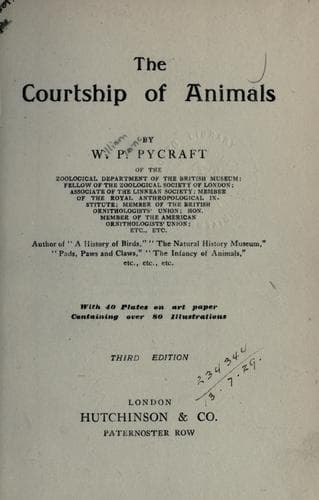
The Courtship of AnimalsPycraft, W. P. (William Plane)
Science
The Courtship of Animals
Pycraft, W. P. (William Plane)
Animal behavior; Natural selection
These facts are the more interesting when contrasted with what obtains
among other fighting species which must woo the females. Take the
case of the common freshwater Stickle-back. In this species the body
is invested with an armature of bony plates and spines in place of
scales, while the males are arrayed in vivid hues of red and blue. Any
survey, however, of the reproductive activities of this little fish
must take into account certain quite remarkable prenuptial actions
and instincts. Briefly, before the male commences his search for a
mate he constructs a nest of fine fragments of aquatic weeds, which
are held together, not by interweaving as with birds’ nests, but by
a sticky and copious secretion from the kidneys. According to some
authorities, this secretion is to be regarded as a pathological product
caused by the undue pressure of the ripening testes. It is difficult
to accept this interpretation, for it might with as much reason be
argued that the copious secretions of the salivary glands of the edible
Swift—which builds a nest constructed entirely of hardened saliva—are
also pathological in character. But be this as it may, the nest
completed, the male seeks a mate, or mates, for polygamy is the rule of
his tribe. In his search for these he has constantly to do battle with
other males, whom he endeavours to disembowl by swift rushes contrived
to t rip open his rival as he passes, by means of one or other of
the erectile spines which project from his back and belly. With the
females whom he desires he uses the arts of peaceful persuasion,
swimming backwards and forwards before her in his endeavour to excite
her amorous instincts. At last he persuades her to enter his bower and
deposit a few eggs, fertilizing them immediately they are laid. The
first to enter leaves by forcing a passage through the opposite wall
of the nest, a happy contrivance, for thereby a current of water can
be constantly driven through, leaving fresh oxygen to the developing
eggs. One female after another is inveigled into the bower, until the
complement of eggs is complete. These, singularly enough, are now taken
charge of by the male. He it is who creates life-sustaining currents
which bathe the eggs, by the rapid vibrations of his breast-fins, and
he it is who protects them from their most persistent enemies—the
females who laid them. As soon as the fry appear the duties of the male
are still further increased. He must guard them from their mothers,
and other foes, and he must prevent their too extensive wanderings.
Such as stray too far afield are sucked into the mouth and brought
back again to the nursery, where they are set at liberty by a reversal
of the sucking action. That the male of a polygamous species, and
with all the attributes of a polygamous species—pugnacity and vivid
coloration—should take upon himself the duties which under like
circumstances among the higher vertebrates are undertaken by the female
is a very remarkable and puzzling feature.
Public-domain text, read in full here on John Shaqi.
Reviews
Reviews
No reviews yet
Be the first to share your thoughts on this work.
Elsewhere in the archive
Join the Discussion
Join the discussion
Sign in to leave a comment or review.
Sign InorCreate an account