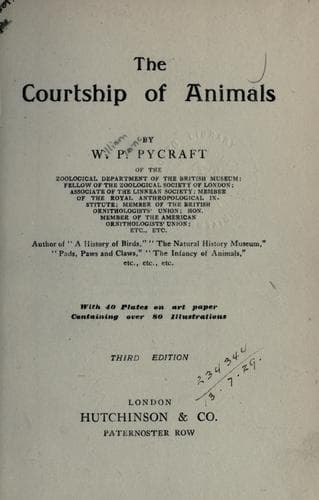
The Courtship of AnimalsPycraft, W. P. (William Plane)
Science
The Courtship of Animals
Pycraft, W. P. (William Plane)
Animal behavior; Natural selection
The Coloration of Animals is generally regarded as a by no means
fortuitous feature, but one, on the contrary, controlled and
determined by various factors. Hence are recognized various kinds
of coloration: Obliterative or Protective-resemblance Coloration;
Warning Coloration; Mimetic Coloration; and Epigamic Coloration, or
the colours associated with courtship. These various types have been
subdivided and accorded technical labels by Professor E. B. Poulton,
in his “Colours of Animals,” but these need not be enlarged upon
here. Suffice it to say that it is generally held that all forms of
coloration can be explained, and all can be labelled, as to their
origin, with more or less certainty. There are those who doubt the
warranty for this classification. Commonly, it must be admitted, the
arguments of these sceptics are not impressive; they are sometimes even
stupid. That such coloration, however it be labelled, is subjected to
some control seems to be shown in the case of the Lepidoptera, for,
generally, in the Butterflies, the upper surface of the wings is much
more vividly coloured than the under surface, and this, apparently,
because when the creature is at rest the wings are brought up over
the back like the leaves of a book, so that the brightly-tinted, and
therefore conspicuous, area is concealed, as, for example, in the “Red
Admiral.” With the Moths the wings, while the creature is at rest, are
held horizontally, and it is the upper instead of the under surface
which is exposed, but the hind-wing is covered by the fore-wing. The
coloration is here very different; for while the exposed surfaces
of the fore-wings are commonly soberly tinted, the hind-wings may
be quite glaringly coloured. These bright colours are exposed only
during flight, or during moments of unusual excitement, as in the
case of the Eyed Hawk-moth. According to Weismann, this insect when
alarmed raises the fore-wings so as to expose the “eye-spots “on the
hind-wings, which, with the increased area of the wings, impart a
terrifying appearance to the body to would-be assailants. This is
as it may be, but for the moment the feature to be insisted upon is
that the bright colours are almost invariably hidden when the insect
is at rest, and by quite different means, determined, apparently, by
the different carriage of the wings. Now, according to some, bright
colours are begotten by strong light, but in the Moth and Butterfly the
surface area of the wing which is most exposed is the surface turned
to the light during rest, and this is the least coloured. The curious
relation between this coloration and the resting position is strikingly
illustrated by the case of one of the “small Blues” (_Lyccenæ_), cited
by Weismann. Herein the male, which has the upper surface of the wings
of a bright blue, rests in the position common to Butterflies—with the
wings raised and concealing the bright colour—while the female, which
Public-domain text, read in full here on John Shaqi.
Reviews
Reviews
No reviews yet
Be the first to share your thoughts on this work.
Elsewhere in the archive
Join the Discussion
Join the discussion
Sign in to leave a comment or review.
Sign InorCreate an account