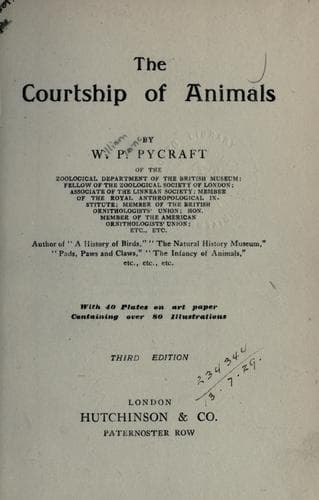
The Courtship of AnimalsPycraft, W. P. (William Plane)
Science
The Courtship of Animals
Pycraft, W. P. (William Plane)
Animal behavior; Natural selection
has the upper surface of a dull brown, rests with the wings expanded.
As, however, the concealed under surface is not brightly coloured, it
is difficult to believe that these different postures and conspicuously
different colours can have been brought into existence solely by the
action of Natural Selection, which, it is generally contended, has
brought about the extinction of those individuals which neglected,
when resting, and therefore liable to be “caught napping,” to conceal
their arresting colours. There is, indeed, no apparent reason why the
female, which has nothing to conceal, should depart from the custom
common to Butterflies, of resting with the wings closed and raised,
this position effectively protecting the male. The facts seem to show
that the coloration of the exposed surfaces of the wings is determined
primarily by some physiological factor rather than by the incidence
of Natural Selection directly through external agencies. Thus, for
example, the action of light on the surface of the wings when in the
resting posture may well inhibit the production of vivid pigment owing
to some inherent physiological idiosyncrasy. But any individuals which
lack this inhibiting factor—as some species which, though resting, are
brightly coloured, appear to do—will be eliminated, if they live in an
environment harbouring eliminating factors, which the exceptions to the
rule we must suppose do not. But on this interpretation the fundamental
factor in the determination of the coloration is the action of light.
Selection imposes a bar only to certain types of coloration.
Some Butterflies and Moths, it has just been hinted, when resting
exhibit bright colours. Our “Swallow-tail” the under surface of the
wings is as brightly tinted as the upper. Among the Moths may be cited
many of the gorgeous Atlas Moths, the Hawk Moths, the beautiful Indian
_Dysphania militaris_—wherein the whole of the exposed surface is of a
beautiful and vivid violet and yellow—and the tropical members of the
Burnet Moths, belonging to the family Syntomidæ. In all these cases it
is not the under but the upper surface of the fore-wings which has thus
departed from the usual rule of the tribe. Not the least remarkable
feature of these insects is the fact that while the Atlas
and Hawk Moths are crepuscular in habits, the Dysphanias and Syntomids
and Burnet Moths are diurnal, and revel in the sunlight.
Public-domain text, read in full here on John Shaqi.
Reviews
Reviews
No reviews yet
Be the first to share your thoughts on this work.
Elsewhere in the archive
Join the Discussion
Join the discussion
Sign in to leave a comment or review.
Sign InorCreate an account