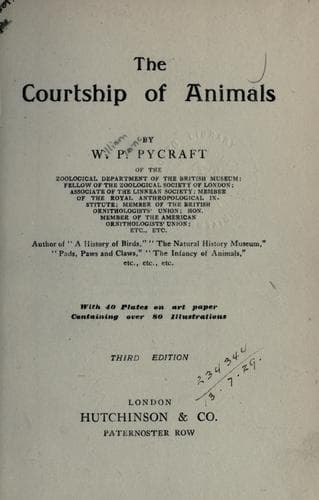
The Courtship of AnimalsPycraft, W. P. (William Plane)
Science
The Courtship of Animals
Pycraft, W. P. (William Plane)
Animal behavior; Natural selection
To revert for a moment to the factors to which these and other bright
and often conspicuous hues are due. That all highly-coloured animals
are descendants of dull-coloured ancestors there can be no room for
doubt. The vivid tints they now display are to be regarded as due to
some change in the metabolism, some clarifying process of the organism
whereby the various pigments became segregated, concentrated and
intensified. But many of the most vivid hues are not due to pigment at
all, but to changes in the surface structure of the coloured areas.
Such are the wonderful metallic colours which all kinds of animals
display. The iridescence is due to the breaking up of the light by
reflection from finely-grooved surfaces.
Whatever their nature, one still asks what is their origin, what
brought them into being. They cannot be regarded simply as adaptations
which have arisen to meet the demands of the environment, as are the
structural peculiarities of the skeleton for example; for in this
case both sexes, and all stages of growth, should display the same
hues, and this is rarely the case. Furthermore, we should not in this
case be left with a vast assemblage of forms which certainly cannot
be “pigeon-holed” as to the nature of their coloration. Such, for
example, as the marine types of birds.
The metallic and iridescent tints to which reference has just been
made, occur among animals to which they can be of but doubtful value,
as in the Golden Mole, for example, or the inside of the Oyster shell.
Their existence in such places well illustrates what we may call the
fortuitous, or apparently fortuitous, beginning of colour of whatever
kind, regarded from an analytical point of view. That is to say, we
are not concerned with the fact that animals are coloured—that is
inseparable from their existence; but with why this coloration should,
in some cases, assume so conspicuous a brilliancy and vividness—a
coloration varying in its character with every species, but apparently
unchanging among the individuals of that species.
No answer to this, likely to find general acceptance, seems to be
forthcoming at present. But it is significant to remark that all
coloration of the kind now under consideration has its origin, as
have most other structural characters, in the male. It is as true of
coloration as of, say, skeletal characters. One turns to the male
for what is new in the history of a species, to the female and young
for indications of past history. It is equally true that in their
coloration one finds the same sequence of development—the male first,
then the female, then the young, till both sexes, and all stages, are
once more alike in hue. And this rule seems to apply to coloration of
all kinds—Protective—Warning—Epigamic.
Public-domain text, read in full here on John Shaqi.
Reviews
Reviews
No reviews yet
Be the first to share your thoughts on this work.
Elsewhere in the archive
Join the Discussion
Join the discussion
Sign in to leave a comment or review.
Sign InorCreate an account