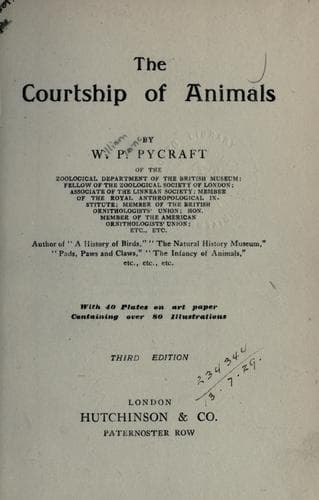
The Courtship of AnimalsPycraft, W. P. (William Plane)
Science
The Courtship of Animals
Pycraft, W. P. (William Plane)
Animal behavior; Natural selection
In this new light, the gaily-bedizened individuals of the Insect world
may be surveyed afresh. The explanation of such of their features as
are commonly attributed to Sexual Selection in terms of female choice,
whereby only the most favoured from among a crowd of suitors could
hope to succeed, may now be replaced by that which obtains also in
the case of the higher animals. It seems to fit the facts better. One
cannot understand, for example, how, on the interpretation of Sexual
Selection, the extraordinary disparity in numbers between the sexes
of some species of Butterflies came about. Thus in that marvellously
beautiful genus Ornithoptera there is one species (_O. brookiana_) in
which the females are excessively rare; so much so that the collector
Kunstler could only obtain fifteen females to one thousand males.
Though the males, among the Butterflies, are commonly much more
numerous than the females, the disparity is rarely so great as with
this species; but there are many in which the proportion of males to
females is as fifty to one. As with the higher vertebrates selection
affords no explanation of this curious disproportion. Though according
to Weismann it fulfills “the first postulate in ‘Sexual Selection’
namely, that there be an unequal number of individuals in the two
sexes.” But Sexual Selection here has a little over-reached itself,
for surely one hundred suitors seems an embarrassing number for an
inexperienced female to have to choose from! To say nothing of the
ninety-nine males doomed to perish without leaving offspring.
That the beauty of colour and form which the Lepidoptera, and
especially the diurnal Lepidoptera, or Butterflies, exhibit is due to
the choice by the females—albeit an unconscious choice—of the most
resplendent of her suitors, that is, in other words, that she yields at
last to the most ravishing member of the crowd—there is no evidence to
show. There would seem to be no possibility of a differential selection
from among a number of males, for there is no “display” comparable to
that, say, of birds. And what is more, it is unlikely that, if there
were, she would find anything to choose between them, for the range
of variation in, say, one hundred males of any given species is very
slight. Finally we have no trustworthy evidence to show that the eyes
of Butterflies and Moths are sufficiently good to enable them to make
nice distinctions between slightly different males. We have no evidence
that the eyes of Insects are capable of discriminating the details of
the often intricate patterns which their own wings, and those of their
suitors, exhibit.
Public-domain text, read in full here on John Shaqi.
Reviews
Reviews
No reviews yet
Be the first to share your thoughts on this work.
Elsewhere in the archive
Join the Discussion
Join the discussion
Sign in to leave a comment or review.
Sign InorCreate an account