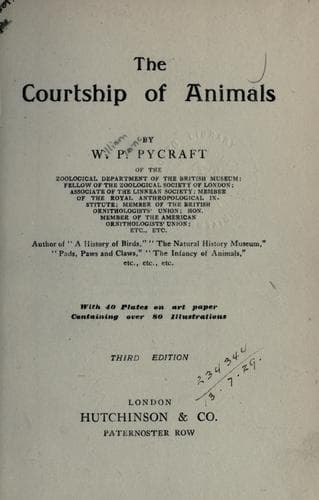
The Courtship of AnimalsPycraft, W. P. (William Plane)
Science
The Courtship of Animals
Pycraft, W. P. (William Plane)
Animal behavior; Natural selection
In the matter of “Secondary Sexual Characters,” indeed, the Lepidoptera
exhibit very little difference between the sexes. As a rule the females
are larger, often strikingly so, but in the matter of coloration they
show far less disparity. But there are exceptions to every rule. A
striking illustration of this is afforded by the genus Ornithoptera.
The butterflies of this superb group are of huge size, and the females
are larger than their consorts, and commonly are extremely different
therefrom both in coloration and habits. In _Ornithoptera paradisea_
this disparity attains its maximum. The female, remarks Mr. David
Sharp, “is a large, sombre creature of black, white and grey colours,
but the male is brilliant with gold and green, and is made additionally
remarkable by a long tail of unusual form on each wing.” But a glance
at the two sexes will show that the female, though less gorgeously
arrayed, still disports a livery which is of a highly specialized
or elaborated character. How are we to account for her differences
in shape, size and coloration on the older interpretation of Sexual
Selection? The perceptual powers, the mentality, of a Butterfly are
surely of a far lower grade than those of a bird, or even a fish. Here,
therefore, we cannot attribute the same possibilities of response to
form and colour which we can ascribe with tolerable safety to the
vertebrates. Yet the Sexual Selection theory as generally understood
demands this.
So far so good. And now as to the part played by Sexual Selection among
the Lepidoptera. Darwin, in formulating this, found its application
to the Lepidoptera a very disconcerting problem, being naturally
disposed to regard the extraordinary wealth of colour which these
insects exhibit as the outcome of a process of female selection, in
every way comparable to that which he held to obtain among the birds.
He did not postulate a conscious, deliberate, selection; but a final
abandonment on the part of the female to the male which, by his beauty
and demonstrativeness, pleased her most. He assumed that at this
critical time she would always be surrounded by rival suitors, offering
varying if slight degrees of difference: and, indeed, in many cases she
is thus surrounded. He remarks, in discussing the case of Butterflies:
“The males sometimes fight together in rivalry, and many may be seen
pursuing or crowding round the same female.” But in the case of the
Silk-moths—and here is another illustration of the merciless criticism
to which he submitted his own theories—he remarks: “The females appear
not to evince the least choice in regard to their partners.” This fact,
which is certainly true in the case of both Butterflies and Moths, and
these gorgeous hues, disconcerted him, as is shown in the passage:
“Unless the female prefer one male to another, the pairing must be left
to mere chance, and this does not appear probable.”
Public-domain text, read in full here on John Shaqi.
Reviews
Reviews
No reviews yet
Be the first to share your thoughts on this work.
Elsewhere in the archive
Join the Discussion
Join the discussion
Sign in to leave a comment or review.
Sign InorCreate an account