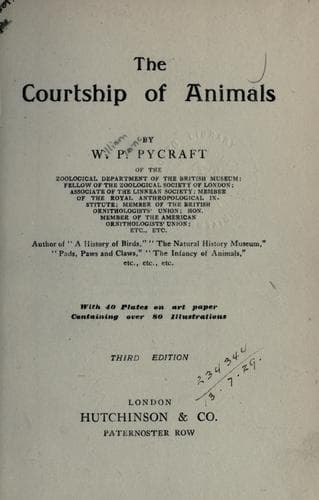
The Courtship of AnimalsPycraft, W. P. (William Plane)
Science
The Courtship of Animals
Pycraft, W. P. (William Plane)
Animal behavior; Natural selection
Mayer next tested the selective action of the females. He began by
removing their wings and affixing to the stumps the wings of males.
The males mated with the females quite as readily as under normal
conditions, though the most conspicuous female characters had been
exchanged for those of the male. After this he affixed female wings
upon the males, but mating took place as usual. The females did not
seem to detect anything unusual in their suitors, nor did normal
males attempt to pair with males bearing female wings. Later he tried
the experiment of dyeing the wings of three hundred males scarlet
or green, and matched these against three hundred which were left
untouched. The disguised, dyed males succeeded in pairing as easily
as their normally-coloured brethren. The females exhibited no choice
whatever. Hence, then, we have further reason to believe that with
the Lepidoptera scent, not sight, is the channel by which mates are
found. So far as the evidence goes, it seems to show conclusively that
in all that concerns sexual relationships, scent is the guiding and
determining factor. By scent the females attract the males, and by
scent of another kind the males sharpen the procreative appetites of
the females.
If the interpretation adopted in these pages is correct, these
manifestations and emanations of colour and scent are readily
accounted for; for they are manifestations of inherent growth changes
which, having started, are free to go on increasing in amplitude
unless, and until, checked by natural selection. There is nothing
unreasonable or improbable in this interpretation; on the contrary,
it embraces also many other features hitherto ignored, but no less
demanding an explanation. Such, for example, as the infinite variety
of form and sculpture which the scales of the wings and the eggs
display. These are details visible only by the aid of the microscope,
but they demand explanation as much as the more obvious characters.
Moreover they have the advantage of belonging to a set of characters
which cannot in any way influence the choice, if choice there be, in
the selection of mates, nor are they of a nature likely to affect the
results of the struggle for existence. Of these characters, then—the
sculpturing of the egg-shell and of the scales, the “nervation” of
the wings, and coloration—we can say no more than that they are
idiosyncrasies of growth, free to develop in any direction unless, and
until, checked by natural selection, which will speedily eliminate
disharmonies with the environment.
CHAPTER XI
BEETLES THAT “BLUFF”
Public-domain text, read in full here on John Shaqi.
Reviews
Reviews
No reviews yet
Be the first to share your thoughts on this work.
Elsewhere in the archive
Join the Discussion
Join the discussion
Sign in to leave a comment or review.
Sign InorCreate an account