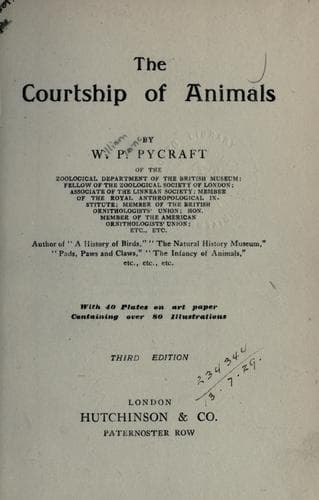
The Courtship of AnimalsPycraft, W. P. (William Plane)
Science
The Courtship of Animals
Pycraft, W. P. (William Plane)
Animal behavior; Natural selection
The Coloration, and other Forms of Ornament in Beetles, and the
Significance thereof in regard to the Sexual Selection Theory—The
Courtship of Grasshoppers and their Kin—The Remarkable Ears of Locusts
and Grasshoppers—The Field-cricket and the Katydid as Troubadours—The
Wonderful Performances of the Cicadas—The Duels of Long-horned
Locusts—Dragon-flies—The May-flies’ “Dance of Death”—The Jaws of
the Giant Alder-fly and their Strange Use—Some Curious Facts about
Stone-flies.
In these pages it is contended that neither brilliant coloration nor
any other form of ornamentation is to be ascribed to the direct action
of “Sexual Selection.” That is to say, such conspicuous features have
not been dependent on the action of female choice for their survival
and development, but are rather the “expression points” of the
internal, inherent growth variations, which, not being inimical to the
welfare of the species, have been free to pursue their development in
any direction which apparent chance may dictate.
The Butterflies and Moths well illustrate this in regard to coloration,
for scent, not colour, would seem to be their principal source of
information as to the outer world. The Beetles are no less instructive;
for these creatures, though they contain numerous highly-coloured
and some exquisitely beautiful species, are more remarkable for
their bizarre shapes, and it seems impossible to regard these as the
products of sexual selection. Yet this is the interpretation of their
origin which, in the judgment of Darwin, we must adopt. He evidently
had misgivings as to the correctness of this view; but it must be
remembered that in reviewing the facts relating to these lower orders
of Creation he was biased by the evidence which he had brought together
in regard to the behaviour of the higher groups under the stimulus of
sexual emotion. Convinced that female choice obtained here, he was
but following the logical result of such conclusions in postulating
the same factor wherever it could conceivably be applied. The most
formidable critic of the Darwinian theory of Sexual Selection was
Darwin himself. The dominant ambition in all his work was to explain
his facts, not to establish his theory; and he was convinced that his
theory of Sexual Selection did achieve that end; though there were
cases where the evidence he was analysing seemed less clear than in
others. That the Beetles presented difficulties is evident from his
comments thereon. He was puzzled by the vivid coloration which some
species present. “They may serve,” he remarks, “as a warning or means
of recognition ... as with Beetles the colours of the two sexes are
generally alike, we have no evidence that they have been gained through
sexual selection; but this is at least possible, for they may have been
developed in one sex and then transferred to the other; and this view
is even in some degree probable in those groups which possess other
well-marked secondary sexual characters....
Public-domain text, read in full here on John Shaqi.
Reviews
Reviews
No reviews yet
Be the first to share your thoughts on this work.
Elsewhere in the archive
Join the Discussion
Join the discussion
Sign in to leave a comment or review.
Sign InorCreate an account