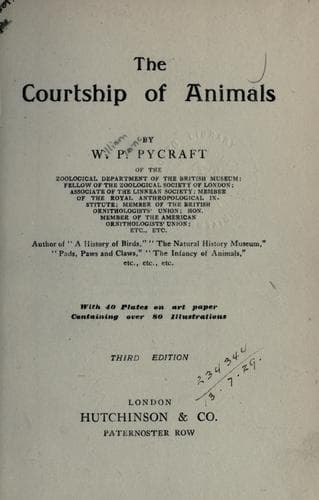
The Courtship of AnimalsPycraft, W. P. (William Plane)
Science
The Courtship of Animals
Pycraft, W. P. (William Plane)
Animal behavior; Natural selection
1 and 2 afford illustrations of the excessive development of “ornament
“; fig. 3 of devices for seizing the female; figs. 4 and 5 of
unaccountable differences in the development of wings.
1. The Pneumatic Cricket (_Pneumora scutellaris_), showing the strange
markings on the female.
2. The Cleft-footed Burrowing Cricket (_Schizodactylus monstrosus_).
3. The Giant Alder-fly (_Corydalis crassicornis_), with its huge jaws
for grasping the female.
4. The Stone-fly (_Perla maxima_), the large-winged Continental form.
5. Loch Tanna Stone-fly (_Isogenus nubecula_), male, with vistigial
wings.
[Face page 220.]
In the Locustidæ the ear is placed on the side of the front leg and
the rim surrounding it may either take an oval shape or close up to
form a slit. The air necessary for the efficient action of the acoustic
apparatus is admitted through a gaping hole in the side of the body,
above the base of the leg, an arrangement not met with among any other
insects. The musical apparatus of these insects differs from that of
the Acridiidæ, for it is formed only by the wing-cases, and not by
the wing case and the leg. One of the wings bears a file on its
inner surface, the other, the right wing, is furnished with a sharp
edge placed on a prominent part of its inner margin. By slightly
tilting the fore-wings, or wing-cases, and vibrating them rapidly,
the edge passes under the file and a musical sound is produced. By
this means one of our native long-horned Grasshoppers (_Locusta
viridissima_) produces a shrill, but not unpleasant, sound, capable of
being sustained continuously for a quarter of an hour. But a species
encountered by Bates during his travels in the Amazons is a much more
efficient performer. Known by the name of Tanana by the natives, it
is so much admired by them for its singing powers that it is kept in
little cages as we keep Canaries. That these organs are of importance
to the species may be gathered from the case of a Bulgarian long-horned
or Green Grasshopper (_Poecilimon affinis_), wherein the wings have so
degenerated as to be useless in flight, but in the male they have been
retained solely as musical instruments. In some species both sexes have
a music-producing apparatus, but as a rule this is present only in the
male.
That these curious and complex stridulating organs do indeed primarily
act as aphrodisiacs seems to have been clearly demonstrated by the
naturalist Bates, who, in speaking of the European Field Cricket
remarks: “The male has been observed to place himself at the entrance
to his burrow, and stridulate until a female approaches, when the
louder notes are succeeded by a more subdued tone, whilst the
successful musician caresses with his antennæ the mate he has won.”
Public-domain text, read in full here on John Shaqi.
Reviews
Reviews
No reviews yet
Be the first to share your thoughts on this work.
Elsewhere in the archive
Join the Discussion
Join the discussion
Sign in to leave a comment or review.
Sign InorCreate an account