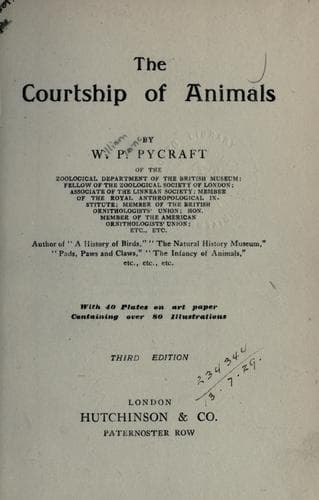
The Courtship of AnimalsPycraft, W. P. (William Plane)
Science
The Courtship of Animals
Pycraft, W. P. (William Plane)
Animal behavior; Natural selection
Among the most efficient and most celebrated performers of all on these
instruments of percussion are the “Katydids” of North America. The
sounds they produce are said to form the words “Katy-did, O-she-did,
Katy-did-she-did.” The first of these extraordinary concerts is heard
about mid-July; by mid-August they are in full song. By others the
sounds have been likened to those produced by the slow turning of a
child’s rattle, ending in a sudden jerk; and this prolonged rattling,
which is peculiar to the male, is always answered by a single, sharp
“chirp” or “tschick” from one or more females, who produce the sound by
a sudden upward jerk of the wings.
Pride of place, however, among insect performances of this kind must
surely be awarded to the Cicadas, which are notoriously the noisiest
members of the Insect world, far eclipsing the shrill calls of the
Grasshoppers and even of the Crickets. Darwin remarks that the noise
they made could “be plainly heard on board the _Beagle_ when anchored
off Brazil at a quarter of a mile from the shore; and Captain Hancock
says it can be heard at a distance of a mile. The Greeks formerly kept,
and the Chinese now keep, these insects in cages for the sake of their
song, so that it must be pleasing to the ears of some men.” Only the
males sing, the females being completely dumb, and this prompted the
Greek poet Xenarchus to make the now famous remark, “Happy the Cicadas’
lives, for they have voiceless wives.” Another naturalist, Riley, says:
“The general noise, on approaching the infested woods, is a combination
of that of a distant threshing-machine and a distant frog-pond.”
Another species, _Tympanoterpes gigas_, also Brazilian, is said to make
a noise equal to the whistle of a locomotive: recalling that of a nest
of young snakes, or young birds, when disturbed—a sort of scream. They
can also produce a chirp like that of a Cricket and a very loud, shrill
screech prolonged for fifteen or twenty seconds, gradually increasing
and decreasing in force.
Public-domain text, read in full here on John Shaqi.
Reviews
Reviews
No reviews yet
Be the first to share your thoughts on this work.
Elsewhere in the archive
Join the Discussion
Join the discussion
Sign in to leave a comment or review.
Sign InorCreate an account