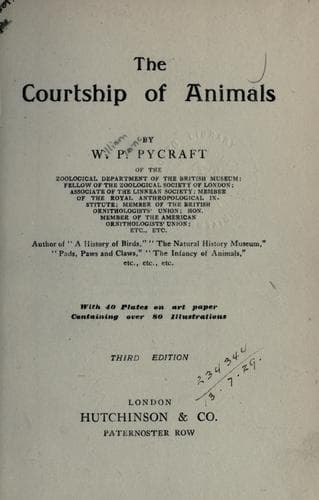
The Courtship of AnimalsPycraft, W. P. (William Plane)
Science
The Courtship of Animals
Pycraft, W. P. (William Plane)
Animal behavior; Natural selection
It is worth noting that there are no wingless Dragon-flies, and that
none have developed unnecessary ornament in the form of spines, horns,
or frills of any kind, such as are so commonly met with among groups of
more sedentary habits like the Phasmidæ and the Beetles, for example.
In other words, there is clearly a direct relation between ornament
and the mode of life. It is also clear that some modes of subsistence
are very inelastic, allowing of no more than very slight structural
variations, for the Dragon-flies are an extremely ancient group. Fossil
species of large size are known from the Lower Lias, and the remains
of a giant measuring two feet in expanse of wings has been found in
the Carboniferous. This species, however, seems to have stood near the
parting of the ways between the May-flies and the Dragon-flies. But
be this as it may, undoubtedly Dragon-flies hovered over the backs of
sleeping Ichthyosaurs and furnished food for Pterodactyles millions of
years ago, as they now hover over lazy kine for the sake of the flies
forgathered there, or dodge to avoid the stoop of the Hobby, and in all
this vast space of time they have not appreciably changed.
And what is true of the Dragon-fly is true also of the May-fly, for it
is clear that they are of the same stock. It is true at any rate in so
far as the conformation of the body is concerned. The possibility that
it may be equally true in regard to the details of their life-history
almost staggers one, because these are, in many respects, of a quite
remarkable character. As with the Dragon-fly, there is a prolonged
period of larval life, lasting from one to two years, which time is
passed in streams and pools where a luxuriant vegetation ensures a
plentiful supply of food. Some are carnivorous, but in the majority of
species minute plants only are eaten. More than forty species are to
be reckoned as natives of the British Islands, the commonest being the
“Green Drake” and “Grey Drake,” beloved by the fisherman. These names
are applied, it may be mentioned, to the phase known as the sub-imago
which precedes the fully-adult stage, of _Ephemera vulgata_ and _E.
danica_.
Public-domain text, read in full here on John Shaqi.
Reviews
Reviews
No reviews yet
Be the first to share your thoughts on this work.
Elsewhere in the archive
Join the Discussion
Join the discussion
Sign in to leave a comment or review.
Sign InorCreate an account