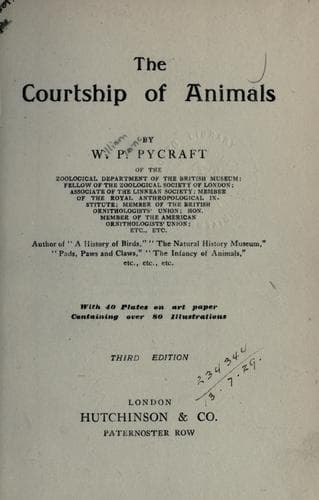
The Courtship of AnimalsPycraft, W. P. (William Plane)
Science
The Courtship of Animals
Pycraft, W. P. (William Plane)
Animal behavior; Natural selection
Save that it is curious that while the larvæ of some species are
carnivorous those of others are vegetarians, there is nothing very
remarkable about what may be called the infantile period. But when
this is ended the span of life remaining to them as adults is brief
indeed. Instinctively realizing that the time of transfiguration is at
hand, the erstwhile crawling grub rises to the surface of the stream,
and almost in the twinkling of an eye it mounts into the air on gauzy
wings, there for a brief space to execute an aerial dance which in its
every phase is amazing. Some species never see the sun. They emerge as
the sky begins to redden, and as its glory fades they, too, expire.
This brief space is all that Nature has allowed them in which to fulfil
her behest to all living things—to increase and multiply. And myriads
die without even a chance to effect this consummation of existence.
The dance is a Dance of Death, and it is performed by a host so vast
as to surpass the bounds of belief save to those who have had the good
fortune to witness a scene so amazing.
D’Albertis tells of a gathering which he witnessed on the Fly River,
New Guinea—for these insects have a world-wide distribution—wherein
countless myriads were assembled. “For miles the surface of the river,
from side to side, was white with them as they hung over it on gauzy
wings; at certain moments, obeying some mysterious signal, they would
rise in the air and then sink down anew like a fall of snow.” And in
this assemblage he estimated that there was but one female to every
five or six thousand males. It is during this flight that the act of
mating is performed. The fortunate male from the host of rivals, in
this mid-air embrace is aided by the foremost pair of legs, which are
especially curved to effect this purpose. The embrace is momentary.
Thereafter he dies; to the female a somewhat longer span of life
remains, for she has yet to deposit her eggs, and this being done _en
masse_, she, too, expires.
It is curious that these creatures, which in their winged state have
never seen the sun, should be attracted by light. But such is the
case. I well remember witnessing an instance of this years ago, while
staying, one August, at Bingen on the Rhine. Dinner was served in the
open air, and just as the soup was served May-flies in myriads swarmed
round the lamps and fell on the tables as thick as snow-flakes. Some
of these were in copula, and I succeeded in bottling a few specimens
for the British Museum, where they still remain to remind me of this
amazing scene.
About three hundred species of May-flies are known, and some enjoy a
somewhat longer span of life than others. In no case, however, do they
emerge till just before sunset; but in some species it is believed life
may be prolonged for as much as three or four days, or even longer, if
the weather be cold and wet, so as to keep them in a state of enforced
rest, which amounts to a state of coma.
Public-domain text, read in full here on John Shaqi.
Reviews
Reviews
No reviews yet
Be the first to share your thoughts on this work.
Elsewhere in the archive
Join the Discussion
Join the discussion
Sign in to leave a comment or review.
Sign InorCreate an account