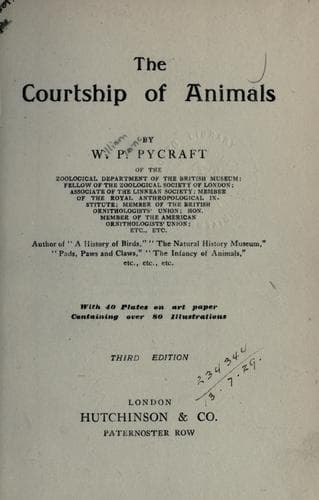
The Courtship of AnimalsPycraft, W. P. (William Plane)
Science
The Courtship of Animals
Pycraft, W. P. (William Plane)
Animal behavior; Natural selection
That the history of the later life of the May-fly is remarkable
no one will deny: in many respects it is unique. Yet for all its
strangeness it enables us to set our compasses, so to speak, in
regard to the phenomena of sex in other groups. The extraordinary
disparity in the proportions between male and female, for example, is
full of significance, for it shows, as has been suggested more than
once in these pages, that, in the case of polygamous species, we are
probably in error in supposing that the excess of females is due to
the reduction in the number of males by reason of the elimination
of males by fighting. The excess of males, or females, as the case
may be, is due to an inherent quality in the germ-plasm. The May-fly
might be regarded as an excessively polyandrous species if the number
of males in relation to females alone be regarded: but actually it
is monogamous. After a prosaic infancy they are suddenly transformed
into gay lovers, dancing a marriage-dance. But for them is no marriage
feast, nor any later sequence of domesticity. One in ten thousand
may find a mate, and only in this is he more fortunate than his
neighbours, for, like them, he too must die before the dawn. Theirs is
not even a sleep and a forgetting, but “one splendid hour of Life, and
then—oblivion.” It may be urged that even these which might seem to
have been fooled, have not really lived in vain, for hosts of animals
feast upon their bodies. Myriads, indeed, are snapped up by fishes even
before they have opened their wings, while birds rudely invade the
swarms as they dance in mid-air, feasting on these fasting ones. But
this is, after all, an inglorious end, and leaves us still asking _Cui
bono_?
Is this amazing life-history a thing of yesterday, a new phase, or an
order of things as old as the origin of the species, dating back some
millions of years?
So far as one can profitably speculate on such a theme it would seem
more likely to be a relatively recent innovation. The nearly-related
Alder-flies (_Sialidæ_), so well known to anglers, seem like to meet
with a similar fate, for the female lives but for a few days only
and the male has an even briefer existence as a winged insect. The
family to which the Alder-flies belong contains a few species which
attain gigantic proportions, as, for example, in the case of the North
American members of the genus _Corydalis_, which are giants. The males
thereof are remarkable for the fact that they are armed with enormous
jaws, which may be likened to a pair of callipers whose limbs have been
crossed. These weapons serve as claspers, enabling the males to seize
and hold the females during the act of mating. But even here the same
brief span of life has to suffice them, for death follows swiftly on
the fulfilment of the nuptial rites.
Public-domain text, read in full here on John Shaqi.
Reviews
Reviews
No reviews yet
Be the first to share your thoughts on this work.
Elsewhere in the archive
Join the Discussion
Join the discussion
Sign in to leave a comment or review.
Sign InorCreate an account