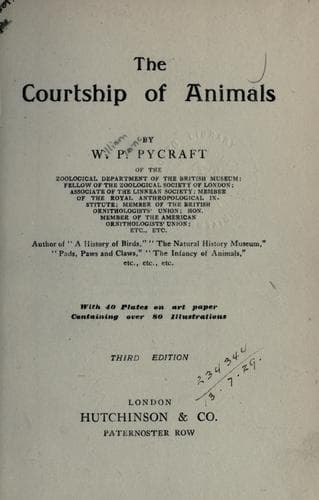
The Courtship of AnimalsPycraft, W. P. (William Plane)
Science
The Courtship of Animals
Pycraft, W. P. (William Plane)
Animal behavior; Natural selection
The Perlidæ, or Stone-flies, which, like the Sialidæ, are aquatic
Neuroptera, the larval stages being passed in streams, present very
puzzling features in regard to the adult males which, so far, have
baffled all attempts at solution; yet they seem to have a very
important bearing on the all-important work of reproduction. They
are among the earliest insects to appear in spring, and possess an
extraordinary power of resisting cold. One species, _Capina vernalis_,
common in the Albany River, in Canada, frequently comes up through
cracks in the ice and casts its skin there! Another, _Nemoura
glacialis_, which appears at about the same time, actually performs
the nuptial rites in crevices in the dissolving ice! Happily reason
is denied them, or they would find life a mockery indeed; for having
attained their final development, when the joyous and exhilarating
exercise of flight should be theirs, they are compelled forthwith
to fulfil their reproductive functions and die—in an ice-chamber!
The males have wings which are rarely or never unfurled; as a rule
they present nothing more than a crumpled mass of gauzy tissue, as if
glued together. Such species as attain to flight are most indifferent
performers, travelling but slowly, with laboured movements and settling
after a few yards have been traversed.
As a rule, among insects, where there is a difference in the power of
flight, it is the male which is superior. The case of _Nemoura_, just
referred to, affords an instance where the contrary is the case, and
Mr. J. J. Lister records the case of one of these flies—_Isogenus
nubecula_—taken at Loch Tanna in Arran, wherein the wings of the female
were greatly reduced, while those of the male were so much so as to be
mere useless vestiges. Similar facts have been recorded of more than
one species in Scotland, but in all such cases the phenomenon seems to
be associated with the appearance of the insect in very early spring.
In another species—_Nemoura trifasciata_—only the front wings are
reduced, the hind pair being large enough to cover the body. In male
specimens of _Perla maxima_ taken in Scotland, the wings are so short
as to be useless for the purposes of flight, yet, in the same species
taken in Central Europe, they are of ample proportions.
These facts are puzzling indeed, but they seem to show that flight is
not essential to attain the ends of reproduction. As to whether these
flies secure their mates by any kind of “courtship,” or how they find
one another, seems not to be known. But the female is remarkable for
the fact that she carries her eggs about with her, to the number of
five or six thousand, attached to the end of the abdomen.
Public-domain text, read in full here on John Shaqi.
Reviews
Reviews
No reviews yet
Be the first to share your thoughts on this work.
Elsewhere in the archive
Join the Discussion
Join the discussion
Sign in to leave a comment or review.
Sign InorCreate an account