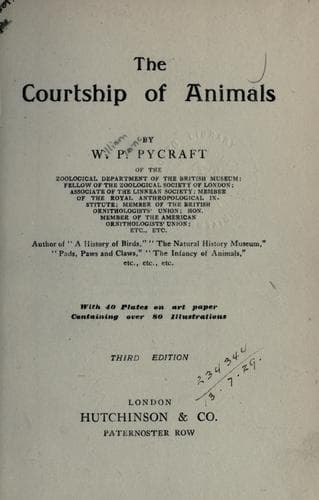
The Courtship of AnimalsPycraft, W. P. (William Plane)
Science
The Courtship of Animals
Pycraft, W. P. (William Plane)
Animal behavior; Natural selection
In cases where the males alone stridulate it is always supposed that
this “music” serves the purpose of a lure, or acts as an excitant, to
the female, even though inaudible to human ears. But there are many
people who are unable to hear the shrill squeal of our native bats. Yet
no one doubts but that all bats hear it. The argument as to the absence
of any sense of hearing in certain Spiders is based on their failure
to respond to the vibrations of a tuning-fork, but this evidence is
not conclusive. Neither is it safe to infer that the presence of
stridulating organs in the adult and immature stages of both sexes,
in some species, precludes their recognition as secondary sexual
characters. They may serve the double purpose of sexual excitants and
terrifying enemies, their motive being expressed by the quality of the
sound as certainly as the timbre of the human voice may express rage or
pleasure.
Neither Spiders nor Scorpions exhibit any very striking secondary
sexual characters. As a rule the female is the larger, often
strikingly so. Bright colours are rare, and are met with only among
the Spiders, wherein sometimes the male, sometimes the female, is the
more resplendent; where bright colours—apple-green, red and yellow—do
occur, they seem rather to be of the type known as Anti-cryptic,
or aggressive resemblance colours. That is to say, they are hues
developed to deceive prey by reason of the likeness they afford the
wearer to its surroundings. Thus, for example, one of our native
Spiders (_Tibellus oblongus_) is straw-coloured, and has an elongated
body, which is therefore seen with difficulty amid dry grass and
rushes which are the haunts of the species. _Misumena vatia_, one of
the Crab-spiders, resembles the flowers on which it is accustomed
to lurk for its prey. It is of a variable hue, commonly yellow or
pink, and a favoured lurking-place is near the blooms of the great
mullein (_Verbascum thapsus_), where it seizes upon bees coming for
honey. Exotic relatives of this species afford far more striking
illustrations of this kind. One has a pink, three-lobed body which
bears a striking likeness to a withered flower, and it exhales a sweet
odour of jasmine. Insects attracted by the smell are thus readily
pounced upon. Dr. Trimen, of Cape Town, describes a rose-red species
which exactly matches an oleander flower, and to complete the deception
the abdomen is marked with white. The same observer, approaching a
bush of the yellow-flowered _Senecio pubigera_, noticed that two of
the numerous butterflies settled upon it did not fly away with their
companions. Each of these he found to be in the clutches of a spider
whose remarkable resemblance to the flower lay not only in its colour,
but in the attitude it assumed. “Holding on to the flower-stalk by
the two hinder pairs of legs, it extended the two long front pairs
upwards and laterally. In this position it was scarcely possible to
Public-domain text, read in full here on John Shaqi.
Reviews
Reviews
No reviews yet
Be the first to share your thoughts on this work.
Elsewhere in the archive
Join the Discussion
Join the discussion
Sign in to leave a comment or review.
Sign InorCreate an account