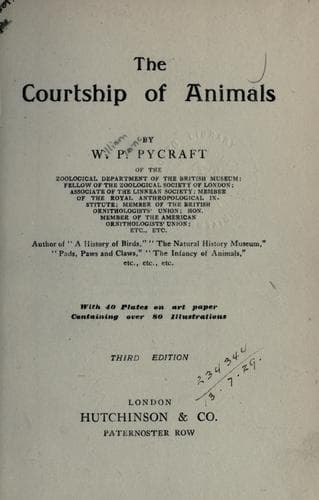
The Courtship of AnimalsPycraft, W. P. (William Plane)
Science
The Courtship of Animals
Pycraft, W. P. (William Plane)
Animal behavior; Natural selection
leaves with its feelers. It is a wood-haunting species, and runs hither
and thither over the ground as if searching for something, and pausing
frequently to “purr.” This singular method of producing sound recalls
that of the drumming of Woodpeckers on the hollow branches of trees,
and similarly is produced without any special mechanism.
That the Scorpions should possess similar stridulating organs is only
what we should expect, having regard to their kinship with the Spiders.
In the great Rock scorpions of India and Africa the stridulating
apparatus lies between the basal segment of the pincers and that of
the first pair of legs, and consists of a set of tubercles and a
cluster of curved, hair-tipped spines. During moments of excitement the
pincers are waved up and down so that the spinules scrape against the
tubercles, emitting a rustling sound, which has been compared to that
produced by rubbing a stiff tooth-brush with one’s finger-nails. In
the South African _Opisthophthalmus_ the mechanism differs, consisting
of leaf-like hairs placed on the inner surface of the jaws. But since
both sexes possess these strange sound-producing mechanisms it has
been suggested that their main, if not their only purpose, is to serve
as a warning to enemies to keep their distance. Some of the great
bird-eating Spiders (_Aviculariidæ_) produce a kind of whistle; others,
sounds like the dropping of shot upon a plate.
These stridulating contrivances present some curious and puzzling
features. In the first place the sounds they produce are never loud
to human ears; therein they differ from the shrill piercing sounds
produced by like mechanism by the Crickets and Grasshoppers, though
even with some of these the notes are, to us, inaudible. In the second,
it has been suggested that where both sexes possess a stridulating
apparatus its purpose is solely to warn off enemies, and this because
the performers have no sense of hearing, and are thus, we presume,
unaware of the sounds they produce. There is something unsatisfactory
about this line of argument. There seems to be no evidence either that
the sounds produced are loud enough to terrify an enemy, or that the
performers are really deaf.
Public-domain text, read in full here on John Shaqi.
Reviews
Reviews
No reviews yet
Be the first to share your thoughts on this work.
Elsewhere in the archive
Join the Discussion
Join the discussion
Sign in to leave a comment or review.
Sign InorCreate an account