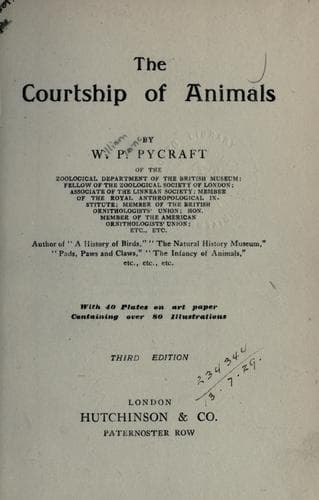
The Courtship of AnimalsPycraft, W. P. (William Plane)
Science
The Courtship of Animals
Pycraft, W. P. (William Plane)
Animal behavior; Natural selection
male intently, but often refuses him in the end, even after dancing
before her for a long time.”
Of another species—_Epiblemum scenicum_—they write: “The females seemed
to have some difficulty in choosing from among the males, but after a
decision has been reached and a male accepted, there appeared to be
complete agreement.” A species of the genus Iritis, which seems to have
baffled identification, was watched for hours under natural conditions
as well as in confinement.” A dozen or more males, and about half as
many females, were assembled together within the length of one of the
rails. The males were rushing hither and thither, dancing opposite now
one female, now another; often two males met each other, when a short
passage of arms followed. They waved their first legs, sidled back and
forth, and then rushed together and clinched, but quickly separated,
neither being hurt, only to run off in search of fairer foes.”
These most patient observers seem to have been convinced that whenever
Spiders possess vividly coloured areas on their bodies they are not
only conscious of this fact, but desire to make the most of such
splendour during the period of love-making. Thus they interpret the
behaviour of a curiously ant-like Spider—_Synageles picata_—which
has the first pair of legs especially thickened, flattened on the
anterior surface, and of a highly iridescent steel-blue colour. As
he approaches the female he pauses “every few moments to rock from
side to side, and to bend his brilliant legs so that she may look
full at them; ... he could not have chosen a better position than
the one he took to make a display.” And similarly they interpret the
movements of another species—_Dendryphantes capitatus_—which has a
bronze-brown face, rendered conspicuous by snow-white bands. The
attitude he assumes when sexually excited is one which seems, to them
at any rate, to serve admirably to expose this feature to the watchful
female. But he has other charms, and his “antics are repeated for a
very long time, often for hours; when at last, the female, either won
by his beauty or worn out by his persistence, accepts his addresses.”
_Habrocestum splendens_—unhappily these creatures have no names in
common speech—possesses an abdomen of a magnificent purplish red, and
the attitude which he assumes at courtship they regard as one designed
to display this to the full. Another case of quite remarkable interest
is that of _Astia vittata_, because the males appear to be dimorphic.
That is to say, they appear under two quite distinct forms, the one
red, like the female; and the other black, with three tufts of hair
just behind the head. The attitudes and the movements of courtship, it
is significant to remark, are entirely different in the two varieties:
the black form, assumed to be the later development, “is much the more
lively of the two, and whenever the varieties were seen to compete for
a female, the black one was successful.”
Public-domain text, read in full here on John Shaqi.
Reviews
Reviews
No reviews yet
Be the first to share your thoughts on this work.
Elsewhere in the archive
Join the Discussion
Join the discussion
Sign in to leave a comment or review.
Sign InorCreate an account