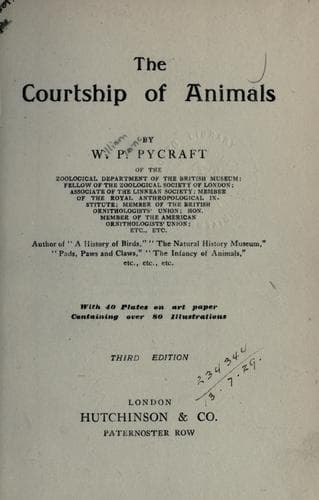
The Courtship of AnimalsPycraft, W. P. (William Plane)
Science
The Courtship of Animals
Pycraft, W. P. (William Plane)
Animal behavior; Natural selection
Professor Poulton, commenting on this particular case, contends that
“it must be admitted that these facts afford the _strongest support_ to
the theory of Sexual Selection.” But do they? A further examination of
the facts will probably show that the red “form” is but an immature
example, and this being so, the difference in performance and the
invariable success of Othello is at once accounted for. The fact that
the “two forms pass into each other” and that the “tufts only occur in
the fully developed _niger_ form” is an additional reason for regarding
the red form as immature.
Professor Poulton remarks: “When the males possess any special
adornment they make a point of displaying them as fully as possible.”
If this be so it seems to be a very foolhardy proceeding, akin to
holding the proverbial “red rag” to a bull: for it is well known that
the male Spider seeking a mate carries his life in his hands, at any
rate in the case of many species. Mr. and Mrs. Peckham observed several
instances of this remarkable sequel to Love’s embraces. In describing
the female of _Phidippus morsitans_ they remark that she was “a savage
monster. The two males we provided for her had offered her only the
merest civilities, when she leaped upon them and killed them.” The
first pair of legs in the males of this species possess “special
adornments” in the shape of long white hairs, and it was “while one
of the males was waving these handsome legs over his head that he was
seized by his mate and devoured.” Again, in the case of a male of
_Phidippus rufus_, the display of his “ornaments” was his undoing,
for he was “caught and eaten when he insisted upon showing off his
fine points too persistently.” Thus the females seem to “select” the
more resplendent males as much for eating as for mating! The ogre-like
habits of the females in this regard, indeed, are almost without
parallel in the animal kingdom.
Anyone who cares to take the trouble to watch the web of the large
Garden Spider (_Epeira diademata_) may witness one of these connubial
tragedies. In this species, the males are conspicuously smaller than
the females, and it is possible that this disparity has been brought
about by Sexual Selection, the largest and least active males having
been exterminated. In some species the discrepancy in size is most
striking, as for example in _Nephila chrysogaster_, the female of which
measures two inches in length, the male not more than one-tenth of an
inch, and less than one one-thousand-three-hundredth part of her weight.
Public-domain text, read in full here on John Shaqi.
Reviews
Reviews
No reviews yet
Be the first to share your thoughts on this work.
Elsewhere in the archive
Join the Discussion
Join the discussion
Sign in to leave a comment or review.
Sign InorCreate an account