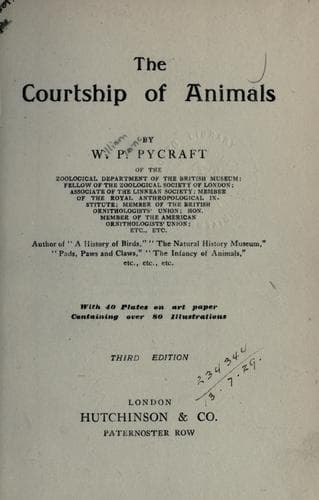
The Courtship of AnimalsPycraft, W. P. (William Plane)
Science
The Courtship of Animals
Pycraft, W. P. (William Plane)
Animal behavior; Natural selection
depends, would scarcely be suspended for a longer period than necessary
for sexual union. Spiders frequently eat one another, and such an
occurrence after pairing is only curious if considered apart from their
habits. When the sexual desire is satisfied, their actions would again
be directed by the dominant instinct of destruction.
It is to be noticed that the attack, when made by a female, often
immediately follows the sexual union, while in the case where males
assume the aggressive it takes place some time afterwards. Mr. Campbell
explains this by the supposition that the action of the female, when
satiated, would be precipitated by the threatened and unacceptable
continued application of the hard, spiny palpus, while the more lasting
desire of the male would have to subside before he became directed by
another instinct. By that time, other attractions, if not his wandering
disposition, would take him away from the web.
The fact that male Spiders are comparatively rare is perhaps explained
by the fact that they are very short-lived; they probably die soon
after pairing—even if they are not eaten! The snares they spin, it is
to be noted, are very imperfect, though curiously enough, when young
they make perfect snares on a small scale.
It will have been noticed, in the course of the foregoing descriptions,
that Spiders display a more or less conspicuous wariness, a cool,
deliberate “counting on the cost” in their matrimonial ventures that is
often wanting in such matters in the human race. But, then, the risks
involved are more patent, more imminent. Mr. Campbell comments on this
intelligent behaviour in the case of the Cellar Spider, remarking that
they measure “each other’s strength when on the same web by the tension
and motion of the threads.”
A word as to the Scorpions. These creatures are near relations of the
Spiders, and in many things resemble them, notably in regard to their
ferocity. One does not meet here, however, with the same disparity in
size between the sexes, nor are vivid colours ever developed. This,
according to some, would be accounted for by the fact that though these
creatures possess numerous eyes they are practically blind, and depend
for their information as to what is going on around them by their sense
of touch, which is excessively delicate. They are morose in disposition
and always solitary. It has been said that if two are found under the
same stone—a favourite lurking-place—one is engaged in eating the
other! Nevertheless, they are of abstemious habits, for the naturalist
Fabre found that from October to March they last, though throughout
this time they remain alert, and always ready to resent disturbance. In
April they exhibit more activity, though even then they eat but little.
But now they begin to wander in search of mates.
Public-domain text, read in full here on John Shaqi.
Reviews
Reviews
No reviews yet
Be the first to share your thoughts on this work.
Elsewhere in the archive
Join the Discussion
Join the discussion
Sign in to leave a comment or review.
Sign InorCreate an account