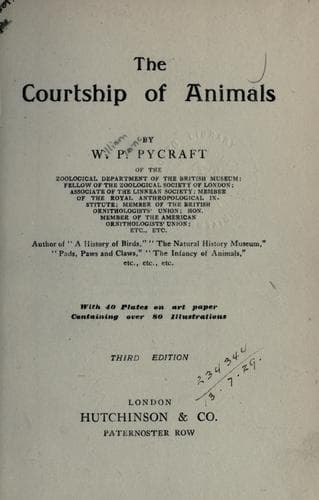
The Courtship of AnimalsPycraft, W. P. (William Plane)
Science
The Courtship of Animals
Pycraft, W. P. (William Plane)
Animal behavior; Natural selection
minutes, and strut with straightened legs round the vase, wagging his
abdomen. Now and then he would remain perfectly still with the palpus
withdrawn, or play with the palpi of the female, while she seemed in
a comatose state. He would then renew the union with undiminished
vigour, appearing on each occasion less desirous of changing his
position. I left them at 12-30 a.m. and returned at 7 a.m. The male
was still using his right palpus. I saw no application of the left
palpus, but have no doubt that it was employed during the night, as
in other cases. I have not observed the pairing ever interrupted by a
fresh collection of semen, although there is no reason to think this
may not occur. The duration of pairing is long; but I am inclined to
think it is more dependent on the difficulty in inserting the palpus
than on sexual endurance. The impregnation appeared to take place
when the male retained his palpi in front of the bursa copulatrices
for about thirty seconds, which was frequently the case.” There
are occasions, however, when a very different sequel attends this
dalliance. In one instance, for example, Mr. Campbell placed a pair
together, and at once the male began to pay his addresses. “Shortly
afterwards he rapidly applied one of his palpi to the female ...
apparently with her consent.” Five hours later “he charged her, tore
away two legs ... and began to suck one, using the mandibles to hold
the limb as a human being would a stick of asparagus.” It is not
surprising to find she died an hour afterwards. An examination of her
remains brought to light the fact that she was not mature. But this
does not apparently explain the ferocity of her partner, for this
investigator on two other occasions saw males similarly dismember
their spouses an hour or so after impregnation. This horrid feast
cannot have been prompted by hunger, for one of these males had, but
a few hours previously, eaten a daddy-long-legs and two blow-flies.
Only twice did this investigator see a female of this species drive
away a male, and in each case immediately after union. “On the other
hand,” he says, “I have kept an adult pair together from the 22nd of
August to the 28th of October, and they lived in perfect amity. The
male never ceased paying unrequited attentions except to feed.” It will
have been remarked that the behaviour of this species in regard to
mating differs conspicuously from the accounts of observations on other
species, wherein the aggressive instincts are displayed by the female.
Mr. Campbell, commenting on these facts, remarks that such conduct is
just what one would expect from creatures which lead solitary lives,
and must have “come to regard weaker forms of animal life as food, or
as an inconvenience, if we except its young or its mate when in the
act of pairing.” Instincts which are habitually practised throughout
the greater portion of the life of the species, and on which existence
Public-domain text, read in full here on John Shaqi.
Reviews
Reviews
No reviews yet
Be the first to share your thoughts on this work.
Elsewhere in the archive
Join the Discussion
Join the discussion
Sign in to leave a comment or review.
Sign InorCreate an account