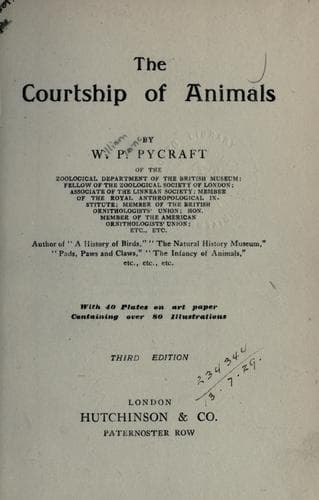
The Courtship of AnimalsPycraft, W. P. (William Plane)
Science
The Courtship of Animals
Pycraft, W. P. (William Plane)
Animal behavior; Natural selection
“Courtship” is the word we commonly employ to describe the act of
wooing; and in civilized human society at any rate, the intensity of
the emotions which inspire the desire to woo are held in restraint by
a variety of causes—and hence the “Courtship.” In the lower animals it
is a moot point whether the term “Courtship” can be accurately applied.
They are governed by no conventions, for them there is neither modesty
nor immodesty. Desire with them is not made to walk delicately,
veiled according to custom; nor is it artificially fostered as among
civilized communities by stimulating food and the crowding together of
large numbers of both sexes in artificial surroundings. Rather it is
a natural, rhythmical, highly emotional state, which gathering force
inhibits the ordinary emotions, or, rather, overrides them, begetting
an intensity of passion which brooks no control. It demands, without
parleying, or mincing matters, what is really the object of courtship
among the civilized human communities—the consummation of the nuptial
ceremony. The term “Courtship” is a Euphemism. Nevertheless, bearing
this in mind, it may conveniently be used in these pages.
We cannot hope to understand the springs of courtship in the human race
from what we observe in present-day society, or even from what we have
gleaned thereon from the records of remote ages. We must get back, so
far as is possible, to the very dawn of the human race: to that period
of man’s evolution when his conduct was controlled by purely savage
instincts. But even then the mark of the beast must have been fading
out. His most valuable asset, his larger brain, even then gave him an
advantage over the Apes, his near relations, and over the beasts of
the field which he had begun to bring into subjection. We may assume
that like his anthropoid relations, he was of a solitary, nomadic
disposition, wandering in small parties from place to place as fancy
or food determined. His advance to this stage started when, by the
activity of his enlarging brain, he began to be oppressed by the gloom
of the forest, and drawn by the fascination of more open country, and
the ever-varying scenes which exploration brought him. But this life
begot new needs and new desires. Hitherto, hunger, self-preservation
and self-perpetuation were the only stimulants which roused his
activities; and they were also the three forces, and powerful forces,
which shaped his love of solitude. The proximity of his fellows
threatened his three most vulnerable points—they competed for his food,
they endangered his life, and threatened the possession of his family.
Public-domain text, read in full here on John Shaqi.
Reviews
Reviews
No reviews yet
Be the first to share your thoughts on this work.
Join the Discussion
Join the discussion
Sign in to leave a comment or review.
Sign InorCreate an account