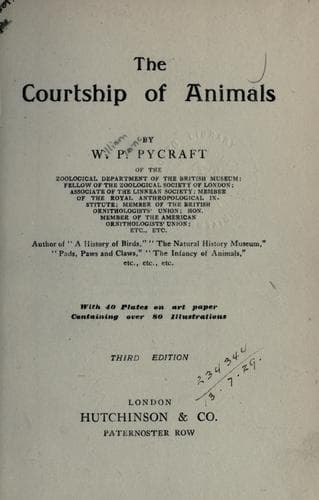
The Courtship of AnimalsPycraft, W. P. (William Plane)
Science
The Courtship of Animals
Pycraft, W. P. (William Plane)
Animal behavior; Natural selection
Many of the Snails, like _Helix nemoralis_, are gaily coloured. Are
these hues, these bands of black and yellow, the product of “sexual
selection”—the outcome of a process of selection from among the most
conspicuously coloured individuals as postulated by the Darwinian
theory of Sexual Selection? If so, then this choice must be regarded
as a periodic recurrence coinciding with the period during which the
individual is dominated by its female attributes. In due course it
becomes, for the time, a male, and may find itself rejected, owing
to a lack of intensity in its coloration, or, on the other hand, it
may vanquish a rival by its very splendour. Each, in short, would
help materially in this process of beautification. If the choice of
mating for it is this rather than a choice of mates—proceeds on these
lines, the bright coloration of the members of this species becomes
easy to understand. But does it? It is more than doubtful whether the
eyes of Snails are sufficiently good to distinguish the coloration
of their neighbours’ shells, or for the matter of that of their own,
for their eyes being carried on long mobile stalks, they should have
no difficulty in contemplating their own charms. And what of Snails
of more sober hues? It seems highly probable that here, as in so
many cases, scent is the selecting factor, and the coloration is an
“accidental” feature. That the colour of the shell plays no such part
as that just postulated may be gathered from the evidence afforded by
many marine species, whose shells, though conspicuously marked, are,
during life, completely enveloped and concealed by the all-investing,
fleshy mantle. In like manner the exquisite beauty in the form and
sculpturing of the shell which so many species exhibit, are characters
which cannot be regarded as due to sexual selection.
As touching the danger of self-fertilization to which reference has
been made. That this is real is shown by the fact that the ova and
spermatozoa are rarely ripe in one individual at the same time.
However, among the pulmonata, or air-breathing gastropods, it seems to
have been established that self-fertilization can, and does, occur.
That in some species, at any rate, where cross-fertilization, for some
reason, is impossible, the individual thus isolated can store up its
own spermatozoa to be used in fertilizing its own eggs. But the fact
that this rarely happens is testimony enough that such occurrences are
inimical to well-being.
Public-domain text, read in full here on John Shaqi.
Reviews
Reviews
No reviews yet
Be the first to share your thoughts on this work.
Elsewhere in the archive
Join the Discussion
Join the discussion
Sign in to leave a comment or review.
Sign InorCreate an account