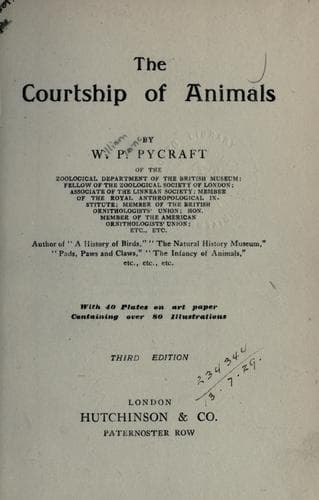
The Courtship of AnimalsPycraft, W. P. (William Plane)
Science
The Courtship of Animals
Pycraft, W. P. (William Plane)
Animal behavior; Natural selection
The Lamellibranch, or bivalve Mollusca, _e.g._, Oyster, Mussel, and
Cockle, afford valuable evidence as to excrescences and extravagances
of growth which appeal to our eyes as ornamental, and therefore likely
to be due to the influence of sexual selection. And this because such
ornamentation is a very conspicuous feature among these animals. Yet,
save in a few cases, locomotion is impossible, and sight is wanting.
Light-distinguishing organs, and therefore eyes, are possessed by some,
but in no case probably are they strong enough to appreciate form.
Even if they did, such revelations of beauty would play no part in
mate selection from among the most ornamental; for these creatures are
commonly fixed throughout life in one position, often, indeed, buried
in mud or sand. Some move laboriously: a few, like the Cockles and
Pectens, swim by rapidly opening and closing the shell. The Pectens
are brilliantly coloured, not only as regards the shell, which is also
beautifully sculptured, but the foot also is of a vivid scarlet, and
the Pecten have numerous minute eyes. But the Cockles and Mussels
possess like attributes as to colour and sculpture, yet they are
blind. More to the point is the fact that these animals do not mate
after the fashion of higher animals, but the males, where the sexes
are distinct, discharge immense quantities of spermatozoa into the
water, and these find their way to the ova of the female through the
action of the inhalent currents set up by the animal for the purpose of
drawing in fresh supplies of water containing food and oxygen. There
are no “secondary sexual characters,” that is to say, that even where
the sexes are separate, and many, like the Oysters, are hermaphrodite,
they are externally indistinguishable. Nevertheless, many, as has been
already remarked, have shells of great beauty. As, for example, the
giant Tridacna and the strangely spinous valves of the “Thorny Oysters”
(_Spondylidæ_).
Public-domain text, read in full here on John Shaqi.
Reviews
Reviews
No reviews yet
Be the first to share your thoughts on this work.
Elsewhere in the archive
Join the Discussion
Join the discussion
Sign in to leave a comment or review.
Sign InorCreate an account