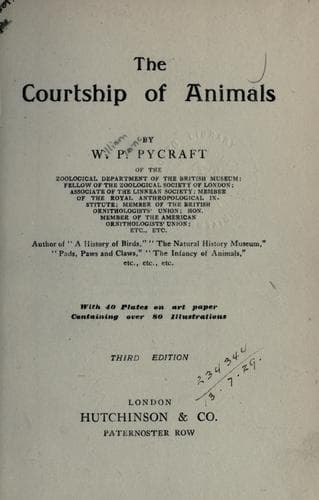
The Courtship of AnimalsPycraft, W. P. (William Plane)
Science
The Courtship of Animals
Pycraft, W. P. (William Plane)
Animal behavior; Natural selection
But what of the drone? He, as has already been mentioned, is reared
in a larger cradle than that of his sisters—save such as are destined
to be queens—and for the first three days of his life is fed on
“bee-milk” of a special kind and more generous quality than that of his
worker—sisters, the Cinderellas of the hive; but this generous diet
is diminished at the end of three days, when a mixture of honey and
pollen is given him. In about three weeks or rather more he emerges, a
great, lazy drone, and for a fortnight more he wanders about the hive
alternately soliciting bee-milk from his sisters and helping himself
to honey from the comb, and when full to repletion he seeks some
snug corner in which to sleep off his surfeit. In due time, however,
he ventures abroad, his hour is at hand. He takes his daily flights
abroad in search of a mate, returning home early in the afternoon for
his rations, being too indolent or too stupid to draw nectar from the
flowers for himself. Thus for many days he and his brothers disport
themselves in riotous living, till one or other of them attains the
end for which he was born; and after a few delirious moments drops
earthwards a mutilated corpse.
But so far only a part of the story of the drone’s life-history has
been told. Though the son of a queen, he has never had a father; and
should he ever attain to the dignity of fatherhood his posthumous
children are all daughters, most of whom die spinsters within six or
seven weeks of their birth, worn out by a life of ceaseless toil and
drudgery!
The queen, it will be remembered, cohabits with the male but once
in her life. The sperm-cells then received are stored in a special
receptacle and are released during the passage of the egg down the
oviduct. In this act of releasing the fertilizing germs a singular
economy is practised. In the case of most other creatures myriads of
sperm-cells are released for the fertilization of a single egg, and
of these but one can possibly attain its goal, the minute aperture or
“micropyle” which is the doorway to the germ liberated, in the form
of an egg, by the female. The rest die. In the case of the queen bee
but one of these precious sperm-cells is liberated at a time. Hence
her prolonged ability to produce fertilized eggs. But eggs destined
to produce males, or drones, are never thus fertilized: they are born
without the intervention of a father. A queen which has never mated
will lay only male-producing eggs. This is an astounding thing, but it
is true. No less remarkable is the fact that the sperm-cells should
survive in their encapsuled state for periods extending over several
years: it seems almost incredible, but it is nevertheless true.
Public-domain text, read in full here on John Shaqi.
Reviews
Reviews
No reviews yet
Be the first to share your thoughts on this work.
Elsewhere in the archive
Join the Discussion
Join the discussion
Sign in to leave a comment or review.
Sign InorCreate an account