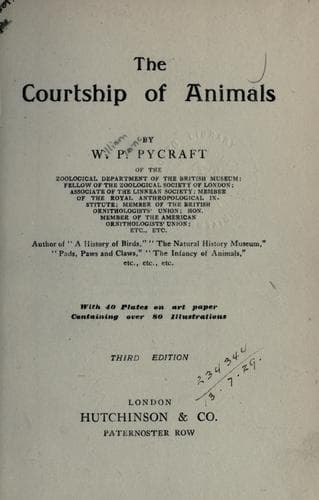
The Courtship of AnimalsPycraft, W. P. (William Plane)
Science
The Courtship of Animals
Pycraft, W. P. (William Plane)
Animal behavior; Natural selection
One cannot suppose that the queen in coming to a drone cell
deliberately withholds the male germ as the egg passes down her
oviduct; some inhibitory factor preventing the release of the
sperm-cell must be brought into play which as yet we have not
discovered. This production of males from unfertilized eggs, or
“parthenogenesis” as it is called, is a common feature among the
hymenoptera, and some other groups of insects, and it occurs also among
other lowly creatures to be described later.
Having regard to the importance of the workers, a brief summary of
their life-history must be given. These, it has already been indicated,
are all, at any rate till three days old, potential queens. Their
development into, or degradation to, the lower grade is determined,
apparently, solely by the quality of the food, for the fact that
queens are reared only in specially constructed cells of large size
with walls of pollen instead of wax is explained by the larger size
of the queen and the need for a more porous, air-permeated cell-wall
on account of the longer time which must be spent in confinement.
The worker is certainly the most “intellectual” member of the hive,
but this superiority has been gained at a great price. Emerging from
the chrysalis skin at about three weeks from the time that the egg
from which she emerged was laid, she begins forthwith to gnaw her way
through the mass of wax and pollen which forms the door of her prison.
Rather, she eats her way through, for the material removed is swallowed
as it is detached, thus the young bee, as Mr. Tickner Edwardes remarks,
is caused to effect her own release by the promptings of her appetite.
Hunger-strikes in the bee community are unknown. Speedily the youngster
steps out, distinguishable from her elder sisters only by her weak,
grey-hued, flaccid appearance. Her first act on gaining freedom is to
groom herself down, after which she proceeds to explore the gloomy,
busy, crowded thoroughfares of the hive. A day or two is thus passed in
gathering strength. On the second appetite returns, and she proceeds
to help herself from the vats of honey and pollen bins scattered here
and there among the cradles of her sisters yet prisoners. But speedily
she is caught and thrust, so to speak, on to the treadmill of work
which is to know no cessation during her short span of life-some six
or seven weeks. Her first duties are those of nursemaid. Without
instruction, or previous experience, she begins to feed her younger
sisters and brothers yet in the larval stage. But besides, during her
first fortnight, before she is allowed to leave the hive she and her
sisters of the same age have to fulfil a variety of tasks. All the
indoor work of the house falls on these Cinderellas. Not only do they,
and they alone, feed the young, but they have to produce the wax and
build the combs and attend to the sanitary arrangements: “they are the
brewers of the honey and the keepers of the stores; they feed the queen
Public-domain text, read in full here on John Shaqi.
Reviews
Reviews
No reviews yet
Be the first to share your thoughts on this work.
Elsewhere in the archive
Join the Discussion
Join the discussion
Sign in to leave a comment or review.
Sign InorCreate an account