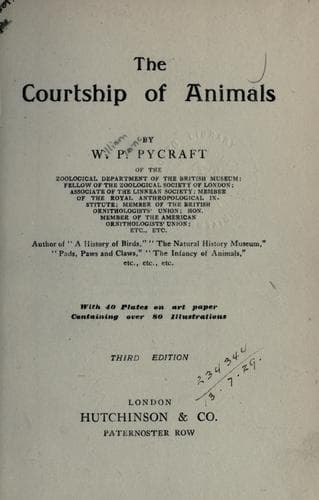
The Courtship of AnimalsPycraft, W. P. (William Plane)
Science
The Courtship of Animals
Pycraft, W. P. (William Plane)
Animal behavior; Natural selection
bee on her ceaseless rounds and give the drones, their brothers, their
daily rations of bee-milk”—what else these lazy creatures need they
take for themselves from the honey-vats. But this is not all. They have
to meet their older sisters returning from the fields and gardens laden
with nectar. This is regurgitated and transferred to the pouches of
the youngsters, by whom it is transformed into honey and stored in the
combs in the upper region of the hive. At the end of about a fortnight
these little drudges are allowed a brief respite, during the heat of
the day, to emerge into the outer air and gather ideas on the world
which is yet to be explored. Soon a measure of freedom is allowed, the
indoor work ceases, and each takes up the new and more agreeable task
of gathering pollen, and after a few days of this the more responsible
task of gathering nectar is undertaken, which is continued till death
ends one of the most crowded, surely, of existences. Such as are born
near “swarming-time” may have the good fortune to take part in the
exodus and the settling down in the new home, and some may taste yet
other moments of excitement, but they are moments only. The worker
bee knows no leisure for the improvement of her mind and morals. She
needs none, for she has neither: she is a creature of routine, a
living automaton apparently. Yet there are incidents in this wonderful
community which seem too complex to be merely the result of instinct
unaided, uninspired, by intelligence albeit of a nebulous kind.
The worker-bees, it has been remarked, are barren: their reproductive
organs are atrophied, and by the decree, not of the queen-mother of the
hive, nor of the males, but of their own caste. In spite of the fact
that they are incapable of producing offspring, they, and they alone,
determine who shall undertake this task; and they decree the fate that
awaits those thus appointed when they can no longer fulfil this purpose.
When the queen, waxing old, and waning in fecundity, lays fewer
and fewer eggs, and these only producing males, they take silent
note of the fact, and at the appointed time decree the death of
their Sovereign-mother. Yet they hesitate to lay violent hands on
her. She, as queen, claimed the right in her early youth to slay
her sister-queens, and sped them with a dagger-thrust; now her turn
comes to die. But it must be a bloodless death, carried out with due
ceremonial. So her daughters cluster about her, and in a mock embrace,
that tightens every moment, her breath is squeezed out of her body.
There are no State pensions for those who are past work, but a State
execution instead. This is vastly more economical, and it may yet
commend itself to some would-be social “reformers,” who will doubtless
contrive to make exceptions to the rule!
Public-domain text, read in full here on John Shaqi.
Reviews
Reviews
No reviews yet
Be the first to share your thoughts on this work.
Elsewhere in the archive
Join the Discussion
Join the discussion
Sign in to leave a comment or review.
Sign InorCreate an account