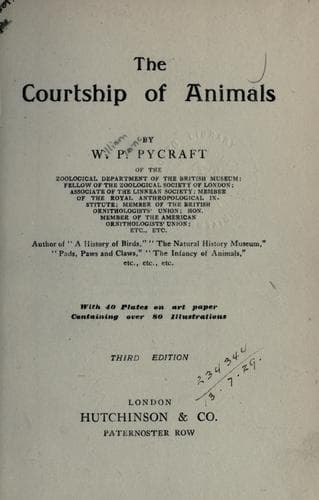
The Courtship of AnimalsPycraft, W. P. (William Plane)
Science
The Courtship of Animals
Pycraft, W. P. (William Plane)
Animal behavior; Natural selection
How—and the question has often been asked—are the experiences of the
infertile females, the workers, transmitted to the germ-plasm? For the
workers, it has been contended, being sterile, are incapable of handing
on such acquirements: this is so. These workers hold the same position
in regard to the species that structures essential to well-being hold
in regard to the individual. These last are not under the control of
the individual, but are determined by a plus or minus quality in its
germ-plasm. The worker-bees are products of the germ-plasm, committed
to the care of the queens. Any strain, so to speak, of that germ-plasm
which gives rise to defective workers brings about its own extinction,
or elimination, sooner or later. Any strain of germ-plasm which
contains, so to speak, a spark of that quality which in the individual
is expressed by intelligent behaviour, will gain advantages in the
struggle for existence.
The complex, the extraordinarily complex, behaviour of the worker-bees
on any interpretation is still mysterious. This interpretation can be
tested only by a reference to the life-history of other social-bees
which have attained to a less complexity. This shows us that the
sterile worker is not to be regarded as a newly-evolved type so much as
an arrested stage of a more complete ancestral condition, and the fact
that the worker is potentially a queen is further evidence of this.
A clue to many of the more puzzling features presented by the domestic
economy of the Hive-bee may be obtained by a study of the life-history
of other species of social-bees which have not attained to so high a
degree of specialization. The Bumble-bees afford illustrations of the
stages through which _Apis mellifica_, the Hive-bee, must have passed.
Public-domain text, read in full here on John Shaqi.
Reviews
Reviews
No reviews yet
Be the first to share your thoughts on this work.
Elsewhere in the archive
Join the Discussion
Join the discussion
Sign in to leave a comment or review.
Sign InorCreate an account