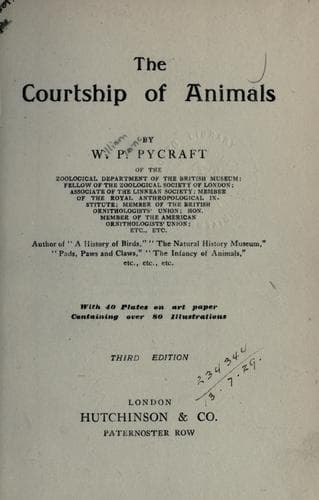
The Courtship of AnimalsPycraft, W. P. (William Plane)
Science
The Courtship of Animals
Pycraft, W. P. (William Plane)
Animal behavior; Natural selection
In the stone Bumble-bee (_Bombus lapidarius_), a queen, who has passed
the winter in blissful sleep, will lay the foundation for a new colony
on some bright May morning by collecting a small quantity of moss. This
done, she starts forth to gather pollen, with which, under cover of the
moss, she forms a waxen cell, mixing the newly-gathered pollen with the
wax so mysteriously formed within her body, as in the case of Hive-bees
of the worker type. Slowly and laboriously this waxen cradle grows.
Fashioned like a globe, its inner surface is lined with pollen soaked
in honey, and with the last pellet of this a number of eggs are laid
arid the nursery is sealed up. By the time these labours are completed
the queen is worn out; she therefore rests awhile, clinging to the
outer wall of this cunningly-wrought cradle. After a few days’ rest she
adds another and commonly yet a third cell to the first, joining each
to the other with wax. But before the third cradle is finished the eggs
in the first have hatched. The youngsters will have consumed the layer
of honey-soaked pollen placed there for this purpose. They therefore
require feeding, and thus the labours of this very industrious queen
are still further increased. Divining the needs of her imprisoned
first-born, she bites a small hole through the nursery wall and pours
in a quantity of honey for their sustenance. In due time they are
“full-fed,” and each spins for itself a silken vestment wherein to
undergo its transformation into a worker-bee. The careful mother,
during this period of transition, now scrapes away an opening through
which the young bees may creep when they awake. This event takes place
in the course of a few days, when her work is materially lightened, for
these newly-hatched workers at once take over the duties of building
nurseries and feeding the further batches of young which, for a time,
follow one another in quick succession. The queen, indeed, has now
nothing else to do but to lay eggs in the nurseries as they are ready.
So far all the children born to her are daughters. The earliest-born,
it is to be noted, were “workers”; those which follow and are tended by
the workers are also females, and supplement their mother’s labours by
producing fertile eggs, though they have never even seen the male of
their own species. Thus, if the queen-mother die her virgin daughters
carry on the colony. But it sometimes happens that she may have left
no descendants capable, for the time, of laying fertile eggs. In this
case, if there be larvæ still in the nursery, the workers feed them
assiduously as if in the hope that some may prove fertile. But if
there be no infants to be fed they apparently abandon work, become
despondent, and spend the greater part of their time sitting at home
by the empty cradles, till at last death comes to their rescue and the
colony is extinct.
Public-domain text, read in full here on John Shaqi.
Reviews
Reviews
No reviews yet
Be the first to share your thoughts on this work.
Elsewhere in the archive
Join the Discussion
Join the discussion
Sign in to leave a comment or review.
Sign InorCreate an account