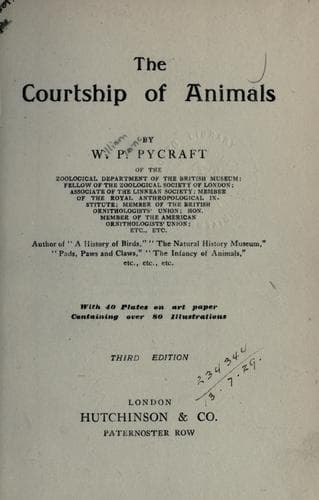
The Courtship of AnimalsPycraft, W. P. (William Plane)
Science
The Courtship of Animals
Pycraft, W. P. (William Plane)
Animal behavior; Natural selection
Much that baffles one in the history of the Hive-bee becomes clear in
the light of the facts revealed by the life-story of the Bumble-bee.
In the first place it will be remembered her first eggs produced only
workers, which appeared at a time when her energies were severely
strained, and their food allowance was no more than barely sufficient
to sustain life. The females which appeared later produced fertile
eggs, having been more abundantly fed by their infertile elder sisters.
The number of fertile females which appear at this stage of the colony
seems again to be regulated by the abundance of food, which varies
in amount with fine, or cold, weather. Even among the worker broods
fertile females may appear. They owe their fertility apparently to good
luck, which afforded them the opportunity of securing more food than
their sisters. The birth of young from females about whose virginity
there can be no question is certainly remarkable, but it would seem
that this parthenogenetic state is one of limited endurance, for
towards the end of summer males appear, and these mating with some of
the later-born females, lead again to the appearance of a queen, who,
being fertilized, alone survives the winter to carry on the race with
the succeeding summer.
Thus, then, the mysterious existence of the workers among the
Hive-bees, displaying structural peculiarities and instincts so
different from those of the queen-mother, is explained. For the queen,
in this case, is evidently the product of a more intensified, more
perfected, social system, relieved, from the first, of the labours
of building and the care of her offspring, duties which the queen
Bumble-bee has at first to perform for herself, because all her
children die at the end of the summer. Among Hive-bees fertile workers
also occasionally occur; they are probably bees which in their larval
state received a more than usually abundant supply of food, or food
approximating to the “bee jelly” which produces young queens. The
difference, then, between the individuals of a colony of Hive-bees and
one of Bumble-bees lies in the greater abundance of fertile workers
and in the fact that the queen of the Hive-bees is relieved of all
work from the first, and so is enabled to devote her whole energies to
the duties of reproduction. She is the descendant of a race of queens
which in earlier times, like the Bumble-bee queen, had to perform
the duties now relegated to her daughters, who inherit not only her
house-building and child-nurturing instincts, but also her potentiality
for child-bearing, though this potentiality is commonly inhibited
by the starvation of the reproductive activities. Selection secures
survival of this state of affairs by the elimination of any tendency
to lose any of these qualities on the part of the queen. The workers
of the Hive-bee, in short, have not evolved their peculiarities of
structure and instinct by some mysterious process of natural selection
Public-domain text, read in full here on John Shaqi.
Reviews
Reviews
No reviews yet
Be the first to share your thoughts on this work.
Elsewhere in the archive
Join the Discussion
Join the discussion
Sign in to leave a comment or review.
Sign InorCreate an account