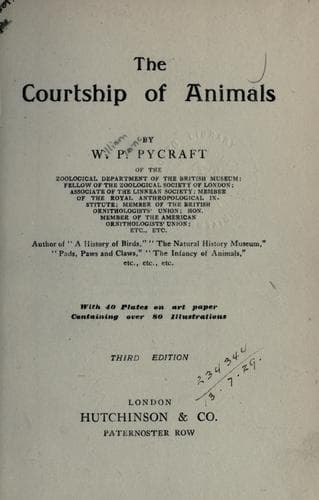
The Courtship of AnimalsPycraft, W. P. (William Plane)
Science
The Courtship of Animals
Pycraft, W. P. (William Plane)
Animal behavior; Natural selection
Each queen, on her descent, departs a separate way, and hard is the
road before her. She left the parental nest well-fed, and in good
liking, her body well, stored with food in the shape of fat and the now
useless, bulky, wing-muscles, and with this, her only dowry, she starts
the formation of a new colony out of her own substance. Her first
task is to form a burrow, and at the end of this she fashions a small
chamber. This done, she closes the mouth of the burrow and cuts herself
off from the world. The labour of this burrowing is so severe that it
often wears away her teeth, her only tools, and the hairs from her
body. In this retreat she now waits patiently for the eggs within her
to ripen, which may take months to accomplish: she is still fasting,
or, rather, feeding upon herself. When at last the eggs are laid and
hatched, she feeds her children on saliva, the very juice of her body,
for she is still fasting. Nor is the strain relaxed till the larvæ
undergo their transformation into pupæ, and, after a brief sleep,
emerge as “worker” Ants, puny in stature owing to the poorness of their
food during larval life. In some species this fast may last for ten
long months. So soon, however, as these little workers emerge, like
dutiful daughters they make their way to the outer world, and go forth
in search of food, which they share with their now exhausted mother.
But, besides, they enlarge the original chamber, and drive galleries in
all directions to provide accommodation for the vast population that
is soon to crowd the thoroughfares. Meanwhile the queen resumes her
task of producing more and yet more daughters, in whom she now displays
not the slightest interest. Her elder children now bear away the eggs,
and feed the young as they hatch. In course of time, as with the Bees,
the task of wet-nurse falls on the youngest of the Ants, those who have
just attained to anthood. For ten or fifteen years this queen-mother
may continue her work of reproduction, a slave, indeed, to domesticity,
with monotonous regularity, checked only by the chill of autumn and the
sleep of winter.
Public-domain text, read in full here on John Shaqi.
Reviews
Reviews
No reviews yet
Be the first to share your thoughts on this work.
Elsewhere in the archive
Join the Discussion
Join the discussion
Sign in to leave a comment or review.
Sign InorCreate an account