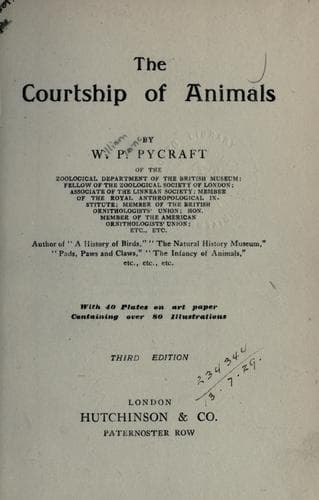
The Courtship of AnimalsPycraft, W. P. (William Plane)
Science
The Courtship of Animals
Pycraft, W. P. (William Plane)
Animal behavior; Natural selection
Those among our own race who profess to hail the prospect of a time
when parthenogenesis shall be the normal mode of reproduction may
well take the Ant as an awful warning. Their ambitions may overreach
the mark. The poor queen becomes a slave to reproduction; children
in myriads are born to her; even if she would she could not sustain
her interest in them, she could not even recognize them as the fruit
of her body. Her daughters are born to a lifelong drudgery, her sons
are mere fertilizing agents: for their only purpose in life is to
perpetuate this awful thraldom, this appalling prolificness; and having
accomplished this, they die forthwith. If there be any joy in this life
it is drunk by the males alone. Thus does the female rule overreach
itself. It is well, indeed, that the participants of the joyous nuptial
flights dancing deliriously on gauzy wings in the glare of a summer
day, have no foreknowledge of the long night that is to follow.
Unlike the Bees, the Ants may produce as many as five grades of
workers, each of which have different duties towards the community. But
the nature of those duties and the manner of the evolution of these
types, are themes foreign to these pages: enough has been said already
to indicate the nature of the problems they present when discussing the
life-history of the Bees.
The subject of parthenogenesis need be pursued no further in this
volume than is sufficient to bring out its retrograde character. It
is a form of reproduction which may be limited to a small number of
generations, as with the Aphides, or to a single generation alternating
with normal sexual generations, as in many Cynipidæ or Gall-flies, or
it may be the only mode of reproduction, as in some other Gall-flies,
some Saw-flies and some Crustacea, wherein no males have ever been
seen. In some species this form of reproduction gives rise to females
only—the Thelyotokous parthenogenesis of scientific text-books—as in
the Saw-flies and Gall-flies, and the parasitic _Tomognatbous_. In
some other Saw-flies, unfertilized queens and workers of Ants, Bees,
and Wasps, which occasionally produce offspring, the progeny is always
male, and this is known as Arrhenotokous parthenogenesis. In one or two
species of Saw-fly, _e.g._ _Nematus curtispina_, both males and females
may be produced, when the species is said to be Deuterotokous.
Public-domain text, read in full here on John Shaqi.
Reviews
Reviews
No reviews yet
Be the first to share your thoughts on this work.
Elsewhere in the archive
Join the Discussion
Join the discussion
Sign in to leave a comment or review.
Sign InorCreate an account