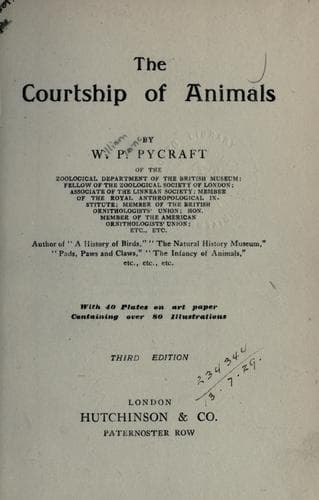
The Courtship of AnimalsPycraft, W. P. (William Plane)
Science
The Courtship of Animals
Pycraft, W. P. (William Plane)
Animal behavior; Natural selection
To explain such a riot of reproduction one might almost suppose these
insects to be imbued with a dread of the impending dissolution of
their race, and endowed with the power to avert such a calamity by
these stupendous efforts; for it is evident that parthenogenesis
confers quite extraordinary powers of raising the birth-rate. But then
the normal mode of procreation is capable of achieving results quite
as remarkable. The queen Termite or White Ant, for instance—which,
by the way, is no Ant, but a near relation of the Stone-flies—when
in her prime will lay eggs at the rate of sixty a minute, or eighty
thousand and upwards in the course of a day of twenty-four hours. But
this unenviable mode of breaking the record is attended, surely, with
some little inconvenience; for to attain to such fertility her abdomen
increases until it attains something like two thousand times that of
the workers of the community in which she lives. That the history of
the queen Termite is unique of its kind is not surprising: indeed, such
an amazing story could only be told of creatures which enjoyed the
seclusion of a subterranean existence. Here, on a bare couch, with her
Royal spouse beside her, she lies, a bloated, heaving mass, incapable
of movement, depositing eggs with the rhythm of a machine, the mother
of offspring which she will never see. A more unsightly picture of
maternity it would be impossible to conceive: it is well, indeed, that
it is hidden from the light of day. No such state of affairs could ever
arise among creatures living an outdoor life, with enemies to avoid,
and food to find.
The instances just surveyed, these extremes of the potentiality of
procreation, are instructive in more ways than one. They are to be
regarded as “excrescences” of reproduction, comparable to those
“excrescences” of individual growth which we call “ornament,” for
example. Individuals on whom this fertility has settled, so to speak,
are the victims of the machinery of sex and reproduction. Their
amazing powers of multiplication are not of their own seeking, they
are inherent manifestations of variations of growth, uncontrollable
save by the machinery of Natural Selection. Incidentally such victims
serve a useful purpose, for their myriad hosts afford food for hordes
of other animals, which in turn are eaten. Little though we realize
it, the well-being of the human race would suffer if these prolific
creatures—the uncomplaining victims of that inexorable law which bids
all living things “increase and multiply” or die—should cease to be;
for with them would disappear a host of animals on whose existence
man’s comfort more or less depends.
Public-domain text, read in full here on John Shaqi.
Reviews
Reviews
No reviews yet
Be the first to share your thoughts on this work.
Elsewhere in the archive
Join the Discussion
Join the discussion
Sign in to leave a comment or review.
Sign InorCreate an account