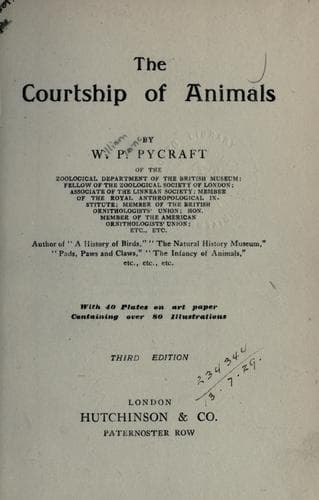
The Courtship of AnimalsPycraft, W. P. (William Plane)
Science
The Courtship of Animals
Pycraft, W. P. (William Plane)
Animal behavior; Natural selection
In the case of the Aphides, winged males normally appear in large
numbers at the end of the summer, and these fertilize the females; but
if kept in a warm green-house, parthenogenetic reproduction may be
sustained for as long as four years. Under quite normal circumstances
these tiny insects show a singular range of variability, for egg-laying
and viviparous individuals are met with; while winged and wingless
generations appear sporadically, apparently according to the abundance
of food. The winged form is sometimes so abundant as to float about
in swarms that darken the air. There are at least three kinds of
males-winged males, wingless males with a functional mouth, and small
wingless males which have no mouth, and, one need hardly say, are
very short-lived. The Aphides are a feeble folk, individually, but
collectively a power in the land, causing at times incalculable loss
to the farmer and gardener; but on this head and on the subject of
their strange habits, and sometimes adventurous lives as slaves in the
service of Ants, no more than a hint may be dropped in these pages.
But some such aids to faith seem to be necessary when those who are
not tolerably familiar with these insects are told of their amazing
fertility. Linnæus long since estimated, in regard to one species,
that in the course of one year a single Aphis will give rise to a
quintillion of descendants—all produced without the aid of a male.
Every one of these females begins to reproduce within from ten to
twenty days of her birth, but even this statement does not bring home
the result of such an astounding fecundity like Huxley’s calculation
which was carefully worked out. He estimated that the produce of a
single female would, in the course of ten generations, supposing all
the individuals to survive—and possess the normal fertility of their
race—“contain more ponderable substance than five hundred millions of
stout men: that is, more than the whole population of China.”
Public-domain text, read in full here on John Shaqi.
Reviews
Reviews
No reviews yet
Be the first to share your thoughts on this work.
Elsewhere in the archive
Join the Discussion
Join the discussion
Sign in to leave a comment or review.
Sign InorCreate an account