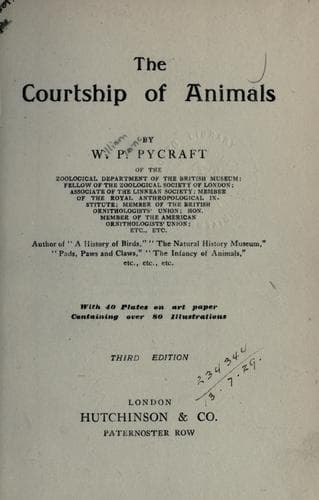
The Courtship of AnimalsPycraft, W. P. (William Plane)
Science
The Courtship of Animals
Pycraft, W. P. (William Plane)
Animal behavior; Natural selection
Another very singular Crustacean, known as _Apus_, bears a curious
superficial likeness to the King Crab (_Limulus_), having a large
back-shield and a long tail. This little creature, a giant compared
with his nearest relations, is an inhabitant of wayside ponds and
ditches. Thousands of females may be taken for years in succession
without the advent of a single male. Then, for some strange reason
which we cannot even guess at, males appear. Like its freshwater
cousin, the Fairy Shrimp, _Apus_ can withstand drought: its favourite
haunts may be transformed into sun-baked hollows, but with a heavy
fall of rain and a few hours’ soaking the eggs left by dead females
develop, and once more the pool and its inhabitants are established
again. Having regard to the extraordinary vitality of these small
creatures, it is curious that they should ever disappear from their
favoured haunts. But they do. Not many years ago _Apus_ could be
found in abundance in many parts of the South of England. It is now
extinct; its last resorts were the ponds at Hampstead: now one may
search in vain for them. “No British specimens,” remarks Dr. Caiman,
a great authority on the Crustacea, “had been recorded for over forty
years, and the species was believed to be extinct in this country,
when it was found in 1907 by Mr. F. Balfour Browne in a brackish marsh
near Southwick, in Kirkcudbrightshire.” These had probably developed
from eggs accidentally transported by some bird from the Continent.
The extinction of the race throughout the British Islands can only
be attributed to the too long absence of males, and the consequent
inability to restore vigour by the more normal method of reproduction
by sexual congress.
Among the Rotifers the little Wheel-animalcules exhibit an even greater
vitality, for not only can their eggs withstand prolonged desiccation,
but in some the body of the animal survives even harsher treatment. If
specimens be enclosed within a chamber containing a little sand or moss
the contents may be dried over sulphuric acid, or heated up to 200° F.,
or left to the neglected dust of years, and will yet revive if a little
fresh water be added to the sand. Males are rare, and when they do
occur are little more than animated receptacles for semen, for they are
incapable of feeding, the gullet and digestive tract being reduced to a
solid cord. A certain amount of nourishment, however, may be absorbed
through the delicate body wall.
Public-domain text, read in full here on John Shaqi.
Reviews
Reviews
No reviews yet
Be the first to share your thoughts on this work.
Elsewhere in the archive
Join the Discussion
Join the discussion
Sign in to leave a comment or review.
Sign InorCreate an account