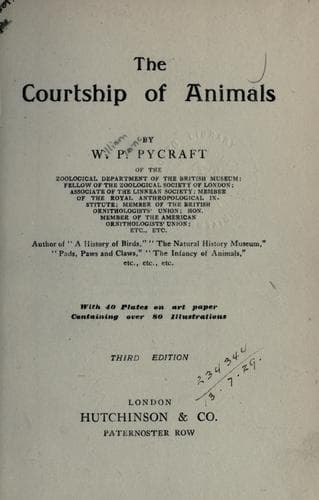
The Courtship of AnimalsPycraft, W. P. (William Plane)
Science
The Courtship of Animals
Pycraft, W. P. (William Plane)
Animal behavior; Natural selection
The degeneration of the males in these parthenogenetic species
irresistibly reminds one of the smile of the Cheshire cat; they grow
smaller and smaller, and their functions less and less, till finally
nothing is left. The “complemental males” discovered years ago by
Darwin in the Barnacles well illustrate this process. In dissecting
adult specimens of the stalked Barnacle (_Scalpellum_) he found, just
inside the valves, in a pocket of the mantle, a varying number of
“complemental males,” tiny organisms which Mr. Geoffrey Smith describes
as “little more than bags of spermatozoa,” and they apparently serve
to fertilize the ripe ova of the larger animal—one cannot say of the
female, for Scalpellum, like most of the Barnacles, is hermaphrodite.
But it is believed that these complemental males are really arrested
hermaphrodites. At any rate, if it so be noted that with some of the
Barnacles, as with some other Crustacea, the larvæ are males, but
when adult life is attained female glands appear and hermaphroditism
is established. Such hermaphrodites have the singular distinction of
being males which have acquired female attributes, true females being
unknown among them!
In one of the parasitic Crustacea (_Chondracanthus_) infesting the
gills of Gurnard, Plaice, Skate and other fish, the adult female is
about half an inch long, and very unlike a Crustacean in appearance;
the male is an extremely minute maggot-like object—a few millimetres
in length—and lives permanently attached to the belly of his mate just
at the base of the egg masses. More remarkable still is the case of
another nearly related parasitic species—_Lernea_—which becomes sexually
mature in its childhood. The males perform their part and die; their
mates arrive at maturity and settle down to a comfortable life as
parasites on fish, reproducing without further mating.
That Parthenogenesis and Hermaphroditism are but specialized forms of
reproduction, leading sooner or later to degeneration and extinction,
there can be no doubt. They are, so to speak, failures in the evolution
of sex, demonstrating in a very forcible fashion the impossibility
of progress—as we understand it—where the sexual functions are thus
combined.
To the differentiation of sex, resulting in separate male and female
individuals, we must attribute the marvellous complexity of the pageant
of life which confronts us to-day. The story of the Courtship of
Animals is only one of an infinite number of incidents in this pageant,
and one which is by no means easy of interpretation.
Public-domain text, read in full here on John Shaqi.
Reviews
Reviews
No reviews yet
Be the first to share your thoughts on this work.
Elsewhere in the archive
Join the Discussion
Join the discussion
Sign in to leave a comment or review.
Sign InorCreate an account