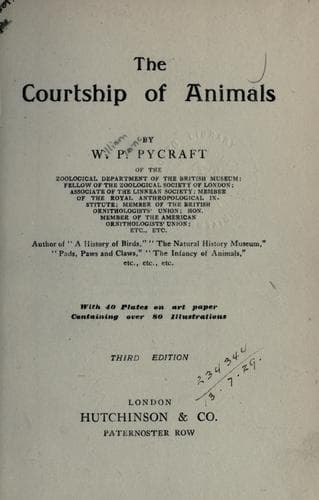
The Courtship of AnimalsPycraft, W. P. (William Plane)
Science
The Courtship of Animals
Pycraft, W. P. (William Plane)
Animal behavior; Natural selection
In these pages an attempt has been made to show that this
differentiation of sex has, throughout, been accompanied by,
and largely moulded by, common instincts and behaviour, and this
interpretation is only to be reached by a study of the phenomena in
their simplest form among the lower grades of animal life. Colour and
the various sexual differences in form have been allowed to dominate
this investigation of the problem of sex, and have diverted attention
from more profitable and fruitful channels.
The lower we descend in the scale of animal life the less convincing
becomes the argument that the colour, ornament or armature of the
males is the result of sexual selection in the older, Darwinian sense.
The argument of Geddes and Thomson and others that the males are more
“katabolic,” the females more “anabolic,” seems no less unsatisfactory,
for in many cases the female is just as highly ornamented as the
male, and in others she is considerably large. Further, in their less
specialized species the sexes are almost or quite indistinguishable
externally, and are sombrely clad, just as at the opposite extreme we
find them equally ornamented and equally active.
We shall be nearer the truth if we regard these secondary sexual
characters as expression points of germinal variations. Though we
seem hopelessly ignorant as to the inciting cause of the variations,
at least we seem to be able to lay a finger on the agents by which
they are effected. And these are the hormones of the primary and
secondary sexual glands, whose functions affect more than the merely
sexual side of the organism. They profoundly affect the coloration of
animals, giving rise on the one hand to purely ornamental “secondary
sexual characters,” and on the other to changes of coloration which
achieve the ends of protective resemblance colours, or of “warning
coloration,” as circumstances may demand. There is nothing more
remarkable in this than the control which the pituitary body exercises
over stature, either when in a pathological condition, or when the
controlling action of the other gland secretions is removed, as by
castration.
Hitherto much has been made of trophic nerves, which control growth;
but it is probable we have overlooked the still more important
action of “trophic” glands, such as the thyroid. This apparently
controls growth in many directions. Adaptations to environment which
are effected by changes in bodily shape-as in the transformation of
land-dwelling mammals into Seals and Whales—are probably largely
controlled by these glands. Their activity is as great as their
manifestation is varied.
Public-domain text, read in full here on John Shaqi.
Reviews
Reviews
No reviews yet
Be the first to share your thoughts on this work.
Elsewhere in the archive
Join the Discussion
Join the discussion
Sign in to leave a comment or review.
Sign InorCreate an account