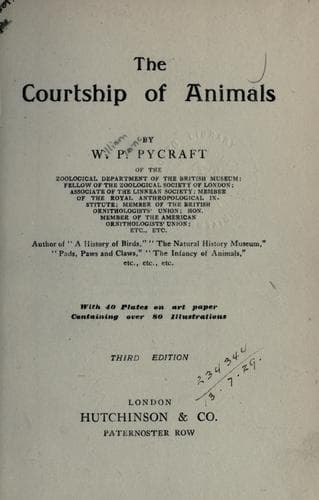
The Courtship of AnimalsPycraft, W. P. (William Plane)
Science
The Courtship of Animals
Pycraft, W. P. (William Plane)
Animal behavior; Natural selection
The species which throw most light on this theme are the Gorilla,
the Chimpanzee and the Orang-utan. Of these the Chimpanzee has most
in common with the human race. But it may satisfy the qualms of many
to know that between the Ape and the Man there is a great gulf fixed.
The brain of the largest Ape is less than half the size of that even
of the lowest of mankind. Man is a reasoning, and for the most part a
reasonable, creature; he is a tool-making animal. This is more than
can be said of any of the apes, even the most intelligent. Their teeth
and immensely powerful arms must serve their every need. No ape ever
fashioned for himself either a knife, a vessel to carry water, or any
means of transport; and herein we have a measure of his brain capacity.
The huge jaws and great canine teeth are no less conspicuous “marks of
the beast.”
These, however, man himself has but recently lost, as was proved by
the sensational discovery of the skull of an ape-like man at Piltdown,
in Sussex, during 1912. Herein the jaw was essentially that of an ape,
while the base of the skull was as markedly human. The cheek teeth, or
molars, were of the human type; but the canine was ape-like, though
much inferior in point of size. That the men of this remote age—which
was possibly that of Pliocene times and certainly not later than early
Pleistocene—had begun to use rudely-fashioned tools, is proved by the
roughly-chipped flints found with the remains. With the invention of
tools the decline in the size of his “eye” teeth began.
Public-domain text, read in full here on John Shaqi.
Reviews
Reviews
No reviews yet
Be the first to share your thoughts on this work.
Join the Discussion
Join the discussion
Sign in to leave a comment or review.
Sign InorCreate an account