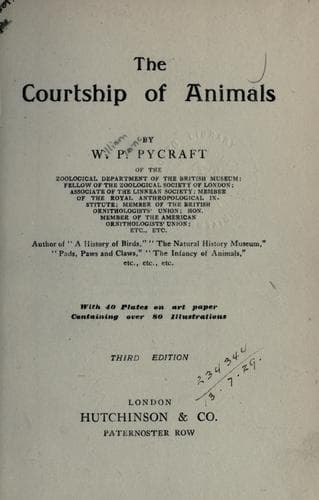
The Courtship of AnimalsPycraft, W. P. (William Plane)
Science
The Courtship of Animals
Pycraft, W. P. (William Plane)
Animal behavior; Natural selection
Reference has been made already to the existence of large sound
resonators for the purpose of increasing the volume of the voice in
the Orang, Gorilla and Chimpanzee. Some of the Gibbons are also well
provided in this direction. But the most striking instances of the
kind are furnished by the Orang, and the monkeys known as Howlers. In
these last the base of the hyoid, as the skeleton for the support of
the tongue is called, is fashioned into a deep bony cup, which has the
effect of intensifying the volume of the voice to a most surprising
extent. But more than this, apparently for the protection of this bony
voice-bowl the upright branches of the lower jaw have become remarkably
deepened, and widened, a correlation of growth between unrelated parts
which is fraught with deep significance. “Terrific,” “terrible” and
“harrowing” are terms which have been used by travellers like Bates,
Belt and Wallace in describing the cavernous roar of these animals, a
roar which will easily carry two miles. It would seem that these vocal
efforts are not merely confined to what we may call the “Courting”
season, as is the roar of the stag, but that they are heard nightly
at dusk. They may be resumed again at dawn, and re-awakened when
thunder-clouds gather. They have become the normal method of giving
vent to excitement, and probably are intensified when isolated males
are desirous of discovering the whereabouts of females equally anxious
to find a mate.
Among the Apes we meet, as with the human species, with both monogamy
and polygamy. But it would be dangerous to assume that the reasons
for polygamy are the same in both. Polygamy, indeed, has by no means
always the same significance. In the most primitive, half-human races
of the past, as with the man-like Apes to-day, polygamy is determined
by accident rather than choice. These extinct peoples, like the great
anthropoids, were normally monogamous, but on the death of a male in
conflict with his neighbour, or from other causes, his mate would
probably of her own free will seek out the nearest male and even if he
were already mated would be at once adopted into the family circle.
This certainly happens in the case of the Gorilla and Chimpanzee
to-day. But among living races of mankind, both savage and civilized,
multiplicity of wives is a matter of choice on the part of the male,
and in many cases to achieve this females from other tribes have to
be secured—either by purchase or conquest. With the lower apes, or
“monkeys,” polygamy only obtains among gregarious species; and either
because the birth-rate of the females exceeds that of the males, or
because a considerable number of young males are killed annually
by exciting the jealousy of the older males, who are exceedingly
pugnacious.
CHAPTER IV
AT DAGGERS DRAWN
Public-domain text, read in full here on John Shaqi.
Reviews
Reviews
No reviews yet
Be the first to share your thoughts on this work.
Join the Discussion
Join the discussion
Sign in to leave a comment or review.
Sign InorCreate an account