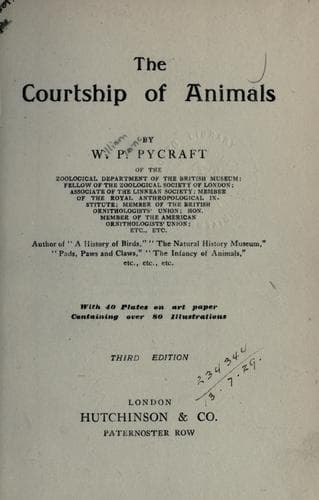
The Courtship of AnimalsPycraft, W. P. (William Plane)
Science
The Courtship of Animals
Pycraft, W. P. (William Plane)
Animal behavior; Natural selection
When the whole of the evidence comes to be surveyed, and not till
then, it becomes apparent that this wonderful diversity is the result
of complex factors. That the conditions of existence have controlled
the results is beyond question; but it is equally certain that these
conditions have been merely controlling and not causative. In other
words, we must regard each of these different groups or types—Deer,
Antelopes, Horses, Elephants, Swine, and so on—as witnesses of what
we call “Heredity.” They are so many “Diathetic types.” That is to
say, the forms, or individuals, belonging to each type have inherited
certain peculiarities in common; they display a “Diathesis” as the
doctors call it: an inherent, inborn tendency, or habit of growth, in
a definite direction: a tendency which, ever and anon, develops new
qualities, takes new directions. And thus it is that we get Oxen—using
this term in its widest sense and not in its special sense—Antelopes,
Goats and Sheep, for example. These have, among other things, a
“diathesis” in the direction of horn production, and each, too, of
a different type. What is meant by this apparently mystifying term
“diathesis” will perhaps be made clear by taking the case of the Ox and
the Sheep. While very different in appearance, these live on precisely
similar food; yet no one has any difficulty in discriminating between
the taste of beef and mutton. In the marvellous chemical laboratory of
the body the grass gathered in the same field is converted into flesh
which even in its uncooked state is easily distinguishable. Though for
the purposes of this illustration domesticated animals have been used,
the same is true of their wild relations. Sportsmen tell us that the
various types of Antelopes and the Zebra, which may be seen feeding
together, have yet flesh of very different qualities. These qualities
are to be attributed neither to “Natural” nor to “Sexual” selection;
they are “accidents.” Similarly, their horns are the witness of a
horn-producing “diathesis”: the various divergencies in curvature,
and in the form of their spirals, or the number of their encircling
rings—as in the horns of Antelopes—are to be interpreted in like
fashion. These twists and turns vary in the same way that the taste of
the flesh varies, and for the same reason; that is to say, they are not
the outcome of “Sexual Selection,” nor have they been brought about by
“Natural Selection” to serve the purpose of “Recognition marks,” as
Wallace would have us believe.
Public-domain text, read in full here on John Shaqi.
Reviews
Reviews
No reviews yet
Be the first to share your thoughts on this work.
Join the Discussion
Join the discussion
Sign in to leave a comment or review.
Sign InorCreate an account