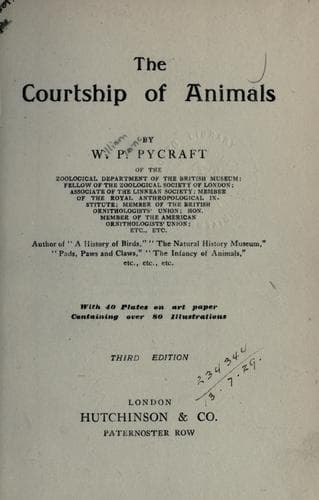
The Courtship of AnimalsPycraft, W. P. (William Plane)
Science
The Courtship of Animals
Pycraft, W. P. (William Plane)
Animal behavior; Natural selection
According to Mr. Townsend, the adult bull, having taken possession of
his territory and formed a harem, is constantly called upon to wage
duels for both with less fortunate rivals. And the severity of such
combats was attested by the deep wounds and festering sores of the
necks of these old warriors—which, at their maximum, attained in the
days of their prosperity a length of nearly thirty feet and a girth of
sixteen feet; but the last survivors of the race to-day seem rarely to
exceed twenty-two feet. The weapons used in fighting are the canines,
and the only armour they possess is that formed by the thickening of
the skin of the neck, which forms a great massive shield, so that
really dangerous wounds are rare. The great fleshy proboscis, the most
vulnerable part, is carefully guarded by the upturned position of the
head. The use of this trunk-like organ, which may attain a length
of about fifteen inches, is not clear; it seems to serve mainly as
an “ornament,” at times, too, furnishing a very definite indication
as to the temper of its owner. While the animal is slowly moving its
great carcase from place to place, this remarkable organ is relaxed,
and pendent; but when fighting it is closely contracted so as to be
out of harm’s way. Whether it plays any useful part in the capture of
food is not known; but it is probably much displayed during phases of
sexual excitement. In young animals, it is significant to notice, as
well as in the adult female this trunk is entirely wanting, which seems
to suggest that this peculiar feature has only been recently acquired,
the young and the adult female, as is the rule, standing nearer to the
early forebears of this strange type. There is an enormous difference,
it should be remarked, between the sexes in the matter of size, the
female not attaining more than half the bulk of her lord. A further
interesting point concerns the coloration of the young, which are
black, while the adults are brown. Doubtless this is connected with the
requirements of the young, the black coat attracting more heat than the
lighter-coloured coat of the adult.
Public-domain text, read in full here on John Shaqi.
Reviews
Reviews
No reviews yet
Be the first to share your thoughts on this work.
Elsewhere in the archive
Join the Discussion
Join the discussion
Sign in to leave a comment or review.
Sign InorCreate an account