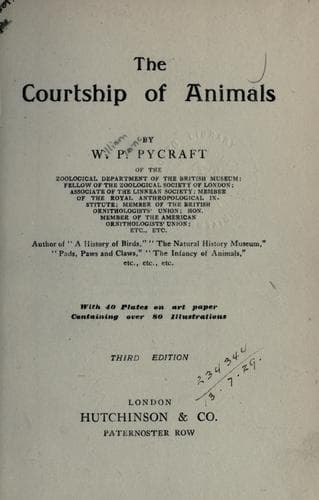
The Courtship of AnimalsPycraft, W. P. (William Plane)
Science
The Courtship of Animals
Pycraft, W. P. (William Plane)
Animal behavior; Natural selection
As touching that curious creature, the Crested, or Hooded Seal
(_Cystophora cristatus_), a native of the colder regions of the North
Atlantic. This animal is remarkable for the development, in the males
alone, of a great crest or casque on the head, which is formed by a
large inflatable air-sac over the ridge of the nose, and communicating
with the nostrils. When fully inflated, it covers the head as far back
as the eye. Its purpose is a matter of conjecture. It seems to be
inflated either when he animal is greatly excited, as when challenging
rival males, or when threatened with danger from other causes, as
when attacked by man. The males are exceedingly pugnacious, and fight
with one another for the possession of females with great ferocity,
such contests being accompanied by cries which can be heard for miles.
From the difficulty which Esquimaux and sealers find in killing the
animal with clubs it certainly seems as if this strange wind-bag were
more than merely ornamental.
[Illustration: Plate 14.
_Photo copyright, W. P. Pycraft._
ELEPHANT SEAL.
This is a young animal. Note the great size of the eyes, and the
general “seal-like” character of the head as compared with that of the
adult.]
[Illustration: _Photo by courtesy of Charles Haskins Townsend, Director
of New York Aquarium._
NORTHERN ELEPHANT SEAL.
Adult male and female, and yearling. The male shows the enormously
inflated snout.
[Face page 88.]
That those extraordinary creatures the Cetacea—the Whales and their
kin—are derived from the same common stock as the typical carnivora
there can nowadays be no doubt, widely as they have departed from
their land-dwelling relatives in almost every possible feature of
their organization. In the matter of their “Courtship” we know
nothing, but we may infer certain incidents in this critical period
of their life-history from the peculiar nature of the secondary
sexual characters which some species display. Thus in the Pilot
Whale (_Globicephalus_) and the Bottle-nose Whale (_Hyperoödon_) the
forehead, in the bulls, is enormously swollen by a mass of fibrous
tissue so dense as to turn the blade of the sharpest knife, as I
know well from attempts to dissect this region. Now the only use,
surely, for such a cushion is that of a battering-ram by rival males
in charging one another, as rams and other horned animals will do. In
the Bottle-nose Whale this cushion is backed up by an enormous mass of
solid bone thrown up by the maxillæ. The origin of this bony growth
is interesting, for it appears first as a slight swelling in the rare
species _Berardius_; it is seen at a further stage of growth in the
female “Bottle-nose” (_Hyperoödon_), and attains its maximum in the
male, where it stands unique. There are two other species which demand
notice here. The first is Layard’s Beaked Whale (_Mesoplodon_); the
second the Narwhal. The former is the only vertebrate which in a wild
state wears a muzzle! In this species the teeth have totally vanished
Public-domain text, read in full here on John Shaqi.
Reviews
Reviews
No reviews yet
Be the first to share your thoughts on this work.
Elsewhere in the archive
Join the Discussion
Join the discussion
Sign in to leave a comment or review.
Sign InorCreate an account