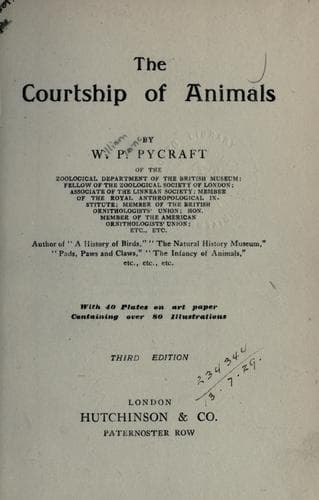
The Courtship of AnimalsPycraft, W. P. (William Plane)
Science
The Courtship of Animals
Pycraft, W. P. (William Plane)
Animal behavior; Natural selection
save for a pair in the lower jaw, which are found towards the end of
the jaw. These in the adult, or perhaps we should say senile, male
grow upwards and inwards, finally meeting one another above the upper
jaw, so as to make it impossible for the animal to open its mouth more
than the fraction of an inch! Surely here we have a secondary sexual
character carried to an excess, and so proving not only disadvantageous
to the animal, but positively disastrous, for it seems clear that so
hampered the creature can feed only on the most minute forms of animal
life, which could only be captured and swallowed with difficulty. It
is true that the Rorquals feed on excessively minute Crustacea, but
they are able to take in enormous quantities at a time, the “whalebone”
serving the office of a sieve to prevent their escape. The Mesoplodon
has no such aids. One is tempted to believe that the skulls displaying
this most curious feature are abnormal, comparable to those, say, of
rabbits wherein the teeth have grown so excessively long as to close
the mouth, on account of the displacement of the cutting surfaces by
accident. But there is nothing to afford support to this view, and one
must therefore fall back on the suggestion of senility.
The Narwhal has long been celebrated for the enormous size of the
canine teeth, the only teeth present in the jaws. As a rule, only
one leaves its bony socket, the other, commonly the right, remaining
as a mere vestige, seven or eight inches long within the skull. The
protruding tooth, which is spirally fluted, may attain a length of
nine feet. Occasionally both teeth are developed, and in this case
the spiral is the same, differing in a very striking manner from
the spiral horns of ruminants, wherein one presents a right, the
other left-handed spiral. But what purpose do these teeth serve? This
question has never yet been definitely settled. Some hold that it is
used to break open breathing holes in the ice, for the animal lives
in the far north: others that it is used as a spear in hunting prey.
Some aver that it serves as a weapon of offence, being used by rival
males in their struggle for mates. Scoresby, the explorer, indeed, says
he has seen young males in mock-battle, fencing with these remarkable
weapons. But until we have more satisfactory data, we must regard this
armature of the Narwhal as affording another instance of a secondary
sexual character of doubtful value to its possessor.
CHAPTER VI
COURTSHIP AMONG BIRDS
Generalities—Darwin v. Wallace—The Peacock in his Pride—The “Display”
of the Peacock Pheasant—The Splendour of the Argus Pheasant and the
Marvel of its Eyes—The Frill of the Amherst Pheasant—Birds of Paradise
in the Toils of Love—Inflated Suitors—Ruffs and Reeves—Fearsome Weapons
and their Uses—Birds which dance—Musical Birds—The Bird’s Voice-box—The
“Lek” of the Capercaillie—Instruments of Percussion—The Curious
Performance of the Wood-pecker.
Public-domain text, read in full here on John Shaqi.
Reviews
Reviews
No reviews yet
Be the first to share your thoughts on this work.
Elsewhere in the archive
Join the Discussion
Join the discussion
Sign in to leave a comment or review.
Sign InorCreate an account