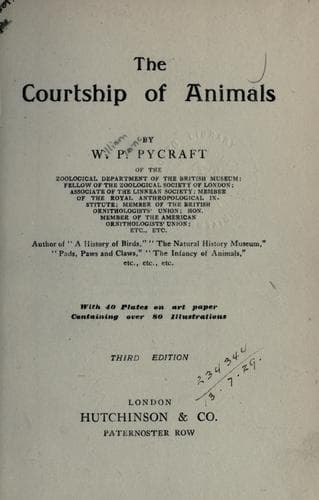
The Courtship of AnimalsPycraft, W. P. (William Plane)
Science
The Courtship of Animals
Pycraft, W. P. (William Plane)
Animal behavior; Natural selection
By way of contrast with the several displays just described, it would
be hard to find a more striking illustration than that afforded by
the Lesser Bird of Paradise (_Paradisea minor_), inasmuch as here the
display is associated with rivalry between a number of individuals.
For much of our knowledge on this subject we have to depend on the
descriptions of natives; but happily this has now been supplemented by
observations made by Mr. Ogilvie Grant on a captive in the Gardens of
the Zoological Society of London.
Impelled by the surging wave of sexual desire, as yet only seeking
consummation, these birds gather together at frequent intervals, on
certain of the forest trees of the Aru Islands, selected apparently
because they present an immense head of spreading branches, and large
but scattered leaves. Here ample space is found for the revels, which
take the form of “Sacaleli,” or dancing-parties, comparable to the
erotic dances of many barbaric races.
By the time the ball opens, the birds, to the number of twenty or more,
have worked themselves up into a state bordering on frenzy, and each
commences his performance with quivering wings and loud, penetrating
cries which may be syllabled as _walk—walk—walk—walk—walk—walk_,
rapidly repeated. Then the wings are suddenly held out on either side,
the tail is bent forward under the branch, and with a quick, barely
perceptible rustle, the gorgeous, golden, diaphanous side-plumes are
thrust upward and forward on each side of the body, forming an arched
cascade above the back. With every muscle tense the performer will
remain in this attitude from ten to twenty seconds, slightly quivering
the wings, and from time to time imparting a tremor to the upraised
plumes. Then follows a second phase. Each bird, seemingly possessed,
commences to dance and hop wildly backwards and forwards along the
bough, and with head bent forward, wings spread horizontally, and the
side plumes raised to their utmost, he gives vent to a series of loud
harsh cries—“ca! ca! ca! ca!” For some seconds he remains in a sort
of ecstasy, rubbing his beak on the bough, and occasionally glancing
backwards below his feet, and with the back fully arched. The climax
passed, he reverts once more to the earlier, more erect stage of the
display, when the paroxysm either gradually subsides or is renewed.
Public-domain text, read in full here on John Shaqi.
Reviews
Reviews
No reviews yet
Be the first to share your thoughts on this work.
Elsewhere in the archive
Join the Discussion
Join the discussion
Sign in to leave a comment or review.
Sign InorCreate an account