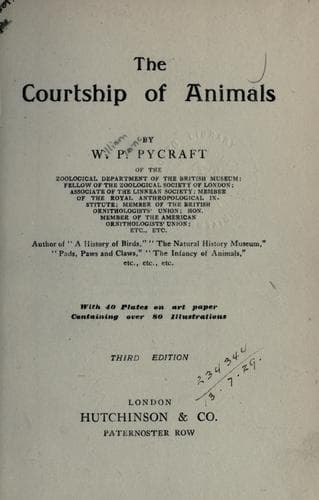
The Courtship of AnimalsPycraft, W. P. (William Plane)
Science
The Courtship of Animals
Pycraft, W. P. (William Plane)
Animal behavior; Natural selection
In this connection it is to be remarked that fighting, of a more or
less sanguinary character, is apparently universal among birds, the
conflicts being waged not so much in the way of squabbles for the
possession of females as for the acquisition and retention of territory
and all that this entails during the breeding season and, to a much
less extent, in the defence of the eggs and young. But to this point
we must return. For the moment it will be more profitable to focus
attention on the character of this fighting. In the first place, it
is by no means necessary that the combatants should be armed. The
“dove of peace” at this time of the year appears in a new and not
always pleasing light, for not only will he fight his neighbours,
but he does not always show that gentleness towards his wife with
which tradition has credited him. The little Humming-bird would seem
to be as little capable of fighting as a bird could be, yet few are
more pugnacious. The naturalist Gosse tells of a pair which had torn
one another’s tongues out in their blind fury; and everybody knows
that Robins and Tits fight savagely to preserve their chosen haunts
from invasion by their neighbours. In some birds this pugnacity has
become an overmastering passion. Some of the Quails, and a species
of Rail (_Gallicrex cristatus_), a near relation of the Moorhen, are
commonly kept by the natives of the East, as our forefathers kept
Fighting-cocks, for the sake of seeing them fight one another. Yet,
save in the case of the Fighting-cock, neither of these birds possesses
any aggressive weapons.
Among the game-birds, however, powerful armature, in the shape of
long, pointed, spurs on the legs are met with. In the Jungle-fowls
and Pheasants only a single pair are found on each leg, but in other
species, as in the Francolins, there are several pairs, and these
birds, it is instructive to notice, are notorious for the ferocity
of their encounters. It is said that in the Indian Swamp-Francolin
(_Francolinus gularis_) nearly every individual is marked by scars and
wounds received in duels with rivals.
Public-domain text, read in full here on John Shaqi.
Reviews
Reviews
No reviews yet
Be the first to share your thoughts on this work.
Elsewhere in the archive
Join the Discussion
Join the discussion
Sign in to leave a comment or review.
Sign InorCreate an account