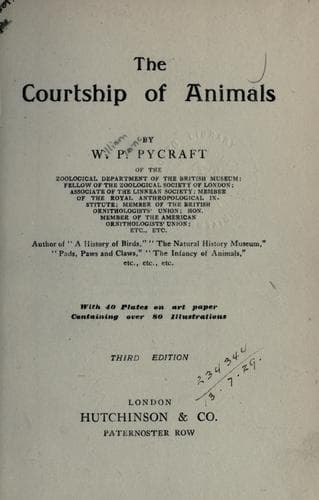
The Courtship of AnimalsPycraft, W. P. (William Plane)
Science
The Courtship of Animals
Pycraft, W. P. (William Plane)
Animal behavior; Natural selection
Certain members of the Plover-tribe, and certain Anserine birds, have
developed spurs of a very formidable character on the wings. Among the
Plover-tribe the best example of such armoured species is the Egyptian
Spur-winged Plover (_Hoplopterus_). This bird, after the fashion
of its unarmoured relatives, such as the Common Lapwing, fights by
turning suddenly in the air and striking with the wings. In the case
of the formidably armed Egyptian bird the result is often fatal; but
with our Lapwing a fatal result is rare, since but slightly swollen
knobs take the place of spurs. In Hoplopterus and in the Jacana this
spur arises from the base of the thumb, but in the Spur-winged Goose
(_Plectropterus_) it is borne by one of the wrist bones (the radial)
while in the aberrant Geese-like birds (_Palamedea_ and _Chauna_) there
are two spurs on each wring, one at each end of the metacarpus. That
these weapons have come into being in response to need seems a very
natural conclusion, but it is one which presents many difficulties
when more closely examined. The wing spurs, differing widely in their
nature as they do, in one case borne on a carpal bone, in others on the
metacarpus, seem rather to owe their origin to fortuitous variations
which have become, so to speak, adopted by selection, than to a
response to the oft-repeated stimuli incidental to fighting. The latter
explanation is Lamarckian and to-day finds favour with but few. The
stimulus theory seems to be effectually discounted by the existence
of the spurs on the legs of gallinaceous birds. That these owe their
origin to impacts, or blows, seems more than doubtful: and one can
hardly see how they could have served any useful purpose until they had
attained a sufficient length to serve as weapons. Even if we suppose
that the spurs of, say, the Jungle-fowl or the Francolin have been
derived from tuberosities such as are found on the legs of the French
Partridge (_Caccabis rufa_), we should still lack evidence that the use
of the legs in fighting caused the origin of the tuberosities.
Public-domain text, read in full here on John Shaqi.
Reviews
Reviews
No reviews yet
Be the first to share your thoughts on this work.
Elsewhere in the archive
Join the Discussion
Join the discussion
Sign in to leave a comment or review.
Sign InorCreate an account