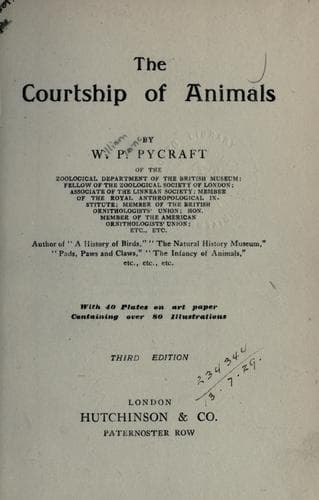
The Courtship of AnimalsPycraft, W. P. (William Plane)
Science
The Courtship of Animals
Pycraft, W. P. (William Plane)
Animal behavior; Natural selection
So far so good. Next it is to be noted that this syrinx presents
a great variety of modifications, or types, differing not only in
plan, but also in the number and distribution of the muscles for its
manipulation. The most accomplished performers are to be found among
that great group of birds known as the Passeres, or perching birds,
wherein the number of these muscles is never less than five pairs,
and generally rises to seven. This association of musculature with
performance is exactly what we should expect. In Nature, however,
it is always the unexpected that happens. In the first place, the
females are, so far as the dissecting-knife and the microscope can
show, as well provided as the males, yet they do not sing. In the
second, the Nightingale and the Crow are equally endowed, so far as
we can discover, yet it is unnecessary to state that the talents
which the Crow possesses are never used! More disconcerting still
is the reflection that the Parrot, which is far less generously
endowed by Nature in so far as singing muscles are concerned, is
a much more skilful performer, inasmuch as it will reproduce with
equal fidelity the human voice and the song of the Canary! The latter
feat, at any rate, has been accomplished with amazing accuracy both
by the little Budgerigar (_Melopsittacus undulatus_) and the Quaker
Parrot (_Myopsittacus monachus_). In their wild state the Parrot
family are notorious for their discordant cries. It is therefore the
more remarkable that such feats should be capable of attainment. But
wherefore the elaborate syrinx of the Nightingale, if the simple type
seen in the Parrot is capable of the same result, and why the elaborate
syrinx in the case of the Crow, which never attains to a greater
perfection of vocal effort than the wild Parrot?
One speaks of the syrinx of the Parrot as of a simpler type because of
its feebler musculature and the lesser complexity of its framework, but
it is nevertheless a more efficient instrument, since it is capable
of reproducing both the human voice and songs such as that of the
Canary. This fact becomes still more remarkable when we reflect that
the natural voice of the Parrot, as we have just remarked, attains to
no more than a harsh screech. How is it that, capable of so much, it
has achieved so little? The same question may be asked in the case of
the Raven. This bird has a syrinx indistinguishable from that of the
Nightingale, save in point of size; yet the Raven’s voice is never
musical, nor can it be trained to such an achievement. Like the Parrot,
however, it can be taught to speak, though its vocabulary is never
so extensive. One would have imagined that when the syrinx of, say,
the Raven, or any of the Crow tribe, was compared with that of the
Nightingale or the Skylark, some structural differences, commensurate
with the difference in performance, would be discovered; but such is
not the case.
Public-domain text, read in full here on John Shaqi.
Reviews
Reviews
No reviews yet
Be the first to share your thoughts on this work.
Elsewhere in the archive
Join the Discussion
Join the discussion
Sign in to leave a comment or review.
Sign InorCreate an account