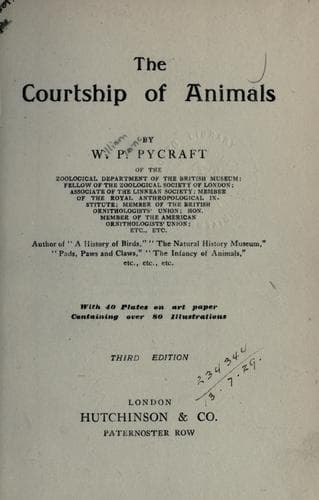
The Courtship of AnimalsPycraft, W. P. (William Plane)
Science
The Courtship of Animals
Pycraft, W. P. (William Plane)
Animal behavior; Natural selection
That the reproductive glands have played, and still play, a by no means
unimportant rôle in Evolution is shown by the history of the secondary
sexual characters. Among the birds, at any rate, the early stages of
physical changes belonging to this “figuration” are to be seen in
various forms of posturing, which in their more elaborate developments
we call “dances.” In many cases, as for example among the Warblers, the
periods of sex-emotion are marked by posturing alone. But in a number
of species, as has already been shown, the products of the sexual gland
seem to have undergone some further elaboration which has resulted in
the additional phenomena of gaudy coloration, in hypertrophied plumes,
and in weapons of offence.
But not yet is the list of such sexual products exhausted, for no
mention has so far been made of the development of the many wonderful
devices for the production of peculiar and arresting sounds, musical
and otherwise. These are of two kinds: one wherein certain feathers
have been modified to produce rhythmical notes either by percussion or
by vibration; the other wherein the internal organs have been modified
to produce musical notes or loud, resonant cries.
Instances of the latter kind are innumerable, and as a consequence no
more than one or two can be cited in these pages. The facts associated
with the production of vocal, as distinct from instrumental, music are
both curious and puzzling. To begin with, this music is produced by
the lower end of the trachea or windpipe, which has become modified in
various ways, though not so strictly in relation to the sounds produced
as is commonly supposed. The anatomical details of these modifications
cannot, or rather need not, be described now, save in the most general
terms.
Briefly the syrinx, or organ of voice, of birds, is formed in part by
the lowermost rings which form the tubular windpipe, and in part by
the smaller pair of tubes which, running therefrom to the lungs, form
the bronchi. These last are formed of semi-rings only, the inner wall
of the tube being formed by very delicate translucent membranes. As
air is forced from the lungs along the bronchi and up the windpipe,
the modulation of the voice is effected by muscles which regulate the
amount of air driven through the syrinx, and the height of the column
in the tube; the latter being effected by muscles which alternately
lengthen and shorten it.
Public-domain text, read in full here on John Shaqi.
Reviews
Reviews
No reviews yet
Be the first to share your thoughts on this work.
Elsewhere in the archive
Join the Discussion
Join the discussion
Sign in to leave a comment or review.
Sign InorCreate an account