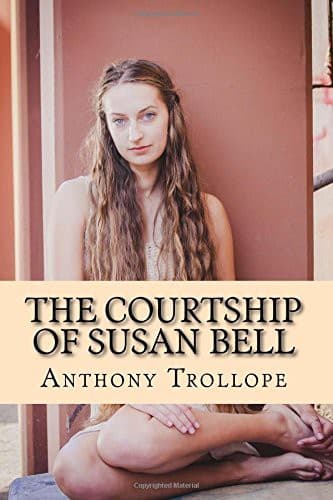
Courtship -- Fiction; New York (State) -- Fiction; Short stories
That Saratoga is a gay place in July, August, and September, the world
knows well enough. To girls who go there with trunks full of muslin and
crinoline, for whom a carriage and pair of horses is always waiting
immediately after dinner, whose fathers’ pockets are bursting with
dollars, it is a very gay place. Dancing and flirtations come as a
matter of course, and matrimony follows after with only too great
rapidity. But the place was not very gay for Hetta or Susan Bell.
In the first place the widow was a timid woman, and among other fears
feared greatly that she should be thought guilty of setting traps for
husbands. Poor mothers! how often are they charged with this sin when
their honest desires go no further than that their bairns may be
“respectit like the lave.” And then she feared flirtations; flirtations
that should be that and nothing more, flirtations that are so destructive
of the heart’s sweetest essence. She feared love also, though she longed
for that as well as feared it;—for her girls, I mean; all such feelings
for herself were long laid under ground;—and then, like a timid creature
as she was, she had other indefinite fears, and among them a great fear
that those girls of hers would be left husbandless,—a phase of life which
after her twelve years of bliss she regarded as anything but desirable.
But the upshot was,—the upshot of so many fears and such small
means,—that Hetta and Susan Bell had but a dull life of it.
Were it not that I am somewhat closely restricted in the number of my
pages, I would describe at full the merits and beauties of Hetta and
Susan Bell. As it is I can but say a few words. At our period of their
lives Hetta was nearly one-and-twenty, and Susan was just nineteen.
Hetta was a short, plump, demure young woman, with the softest smoothed
hair, and the brownest brightest eyes. She was very useful in the house,
good at corn cakes, and thought much, particularly in these latter
months, of her religious duties. Her sister in the privacy of their own
little room would sometimes twit her with the admiring patience with
which she would listen to the lengthened eloquence of Mr. Phineas
Beckard, the Baptist minister. Now Mr. Phineas Beckard was a bachelor.
Susan was not so good a girl in the kitchen or about the house as was her
sister; but she was bright in the parlour, and if that motherly heart
could have been made to give out its inmost secret—which however, it
could not have been made to give out in any way painful to dear
Hetta—perhaps it might have been found that Susan was loved with the
closest love. She was taller than her sister, and lighter; her eyes were
blue as were her mother’s; her hair was brighter than Hetta’s, but not
always so singularly neat. She had a dimple on her chin, whereas Hetta
had none; dimples on her cheeks too, when she smiled; and, oh, such a
mouth! There; my allowance of pages permits no more.
Public-domain text, read in full here on John Shaqi.
Reviews
Reviews
No reviews yet
Be the first to share your thoughts on this work.
Join the Discussion
Join the discussion
Sign in to leave a comment or review.
Sign InorCreate an account