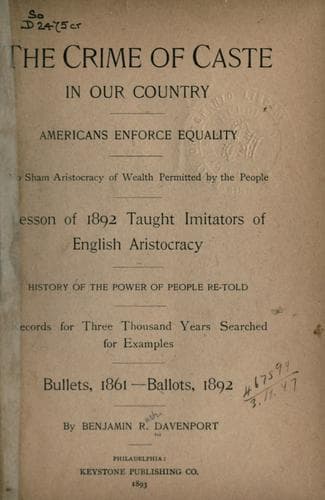
The Crime of Caste in Our CountryDavenport, Benjamin Rush
History
The Crime of Caste in Our Country
Davenport, Benjamin Rush
Social problems; United States -- Social conditions -- 1865-1918
Not only is it un-American, but especially obnoxious to the people
generally, as it tends toward the accumulation of wealth, not only
to an unwholesome but to an alarming degree, in the hands of the
eldest sons of these families. It is practically the entailment of the
estate, without so announcing it. Let us take, for example, the Goulds,
Vanderbilts, or Astors, and let this peculiar kind of distribution of
their property continue, apportioning out the younger members of the
family with a comparatively small sum, but leaving the bulk to the
first son. Is it not concentrating wealth in the hands of one man, the
income of which it is impossible that he should spend? The accumulation
still goes on from generation to generation until, practically, the
money power of our land lies within the grasp of the representatives of
a few families. Let us imagine the condition of affairs a few hundred
years hence, if we allow the Vanderbilts, Goulds, Rockefellers and
Astors to apportion off, from generation to generation, the younger
sons and daughters of the family, concentrating the vast accumulation
from the interests of their tremendous fortunes in the hands of one
representative of the family. Some dozen men of this great Republic,
by a combination, could then practically control at all times the
financial situation of the nation. There is no possibility of an
equalizing process and the scattering of the wealth and accumulations
of these families. From generation to generation, under this peculiar
method of distribution and disposal adopted by our would-be nobility,
there would be created a condition exactly similar to that existing in
the pre-eminently commercial Venice, from which thraldom the Common
People were only relieved by a foreign conqueror, Napoleon, whom they
welcomed with unpatriotic joy because he brought relief from the
discriminations with which the masses were cursed.
No one will deny that, under the existing laws, Mr. W. H. Vanderbilt,
the gentleman (?) who so forcefully and elegantly expressed himself in
the utterance of his sentiments, “The public be damned,” had a perfect
right, under the laws as they now exist, to leave the bulk of his
property to his eldest son. Nay, he might have called him the Duke of
Vanderbilt, if he pleased. By the pleasure of the people, he had the
right to dispose of his possessions as to him seemed best.
[Illustration: WM. H. VANDERBILT,
AUTHOR OF THE FAMOUS SPEECH, “THE PUBLIC BE D----D.”]
Public-domain text, read in full here on John Shaqi.
Reviews
Reviews
No reviews yet
Be the first to share your thoughts on this work.
Elsewhere in the archive
Join the Discussion
Join the discussion
Sign in to leave a comment or review.
Sign InorCreate an account