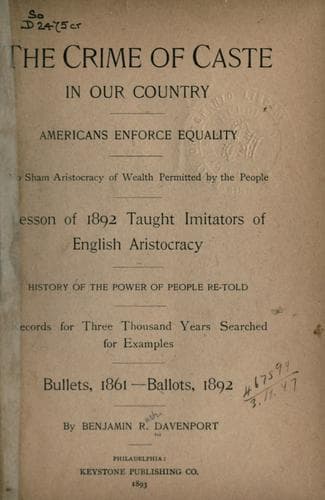
The Crime of Caste in Our CountryDavenport, Benjamin Rush
History
The Crime of Caste in Our Country
Davenport, Benjamin Rush
Social problems; United States -- Social conditions -- 1865-1918
This is all perfectly within the bounds of and consistent with the laws
that the people have made; but remember, that these people who made
these laws can UNMAKE them; they can require that a man’s property
shall be equally divided among all of his children; they can tax it so
that this infernal and ever-increasing income shall not create such
an accumulation as to present a danger to the life and existence of
the Republic. And this is not against the law. Good my lords, as the
barons, the Common People will kill this “caste,” not by the headsman’s
axe that decapitated the Stuart, not by the guillotine that drank the
blood of a Bourbon; but they’ll do it with legislation, more peaceful,
more quiet, and with more “general apathy;” but the result will be just
as efficacious.
Now that the nation, composed of the Common People of America, has
suffered the assumption, upon the part of these few families, of a sham
aristocracy and attempted “caste” in this country; suppose, when the
people have felt the power that lies in them, that they should rise in
their might and decree that the support of the Federal Government shall
come from that surplus income, instead of permitting it to accumulate
in the hands of each succeeding generation of a few families in
America. What, again it may be asked, can the sham aristocrats do about
it?--you people of the Carnegie, Astor, Vanderbilt class. The people
decree it, and you must bow your heads to their will.
The people are not socialistic. They do not believe in the division
of property. Men like Dolan, at the Clover Club in Philadelphia, and
others of his kind, deliberately libel and traduce the Common People
when they pretend to explain the defeat of the Republican party upon
the ground of a socialistic tendency in the people of this nation. The
lie is apparent by the action of the militia, composed of the Common
People, both at Homestead and Buffalo. The people are for law and order.
The poor man’s morals are quite as good or better than the morals of
the rich. His home is as sacred, and the slimy serpent of Nihilism is
as objectionable in his home as it would be to the millionaire in his
palace of grandeur. The little holdings of the poor man, his farm, his
tool chest, and his furniture, are his; and he holds the right to own
them as dear as Astor holds his right to his property in many hundred
houses. The poor man, the Common People, nowhere in this broad Union
wants anarchy. He’ll stamp it out, as he did in Chicago, and it is a
libel upon him and the nation, for the rich and those who would impose
the yoke of “caste,” to attempt to wave the bloody shirt of Socialism
by their speeches on this subject.
Public-domain text, read in full here on John Shaqi.
Reviews
Reviews
No reviews yet
Be the first to share your thoughts on this work.
Elsewhere in the archive
Join the Discussion
Join the discussion
Sign in to leave a comment or review.
Sign InorCreate an account